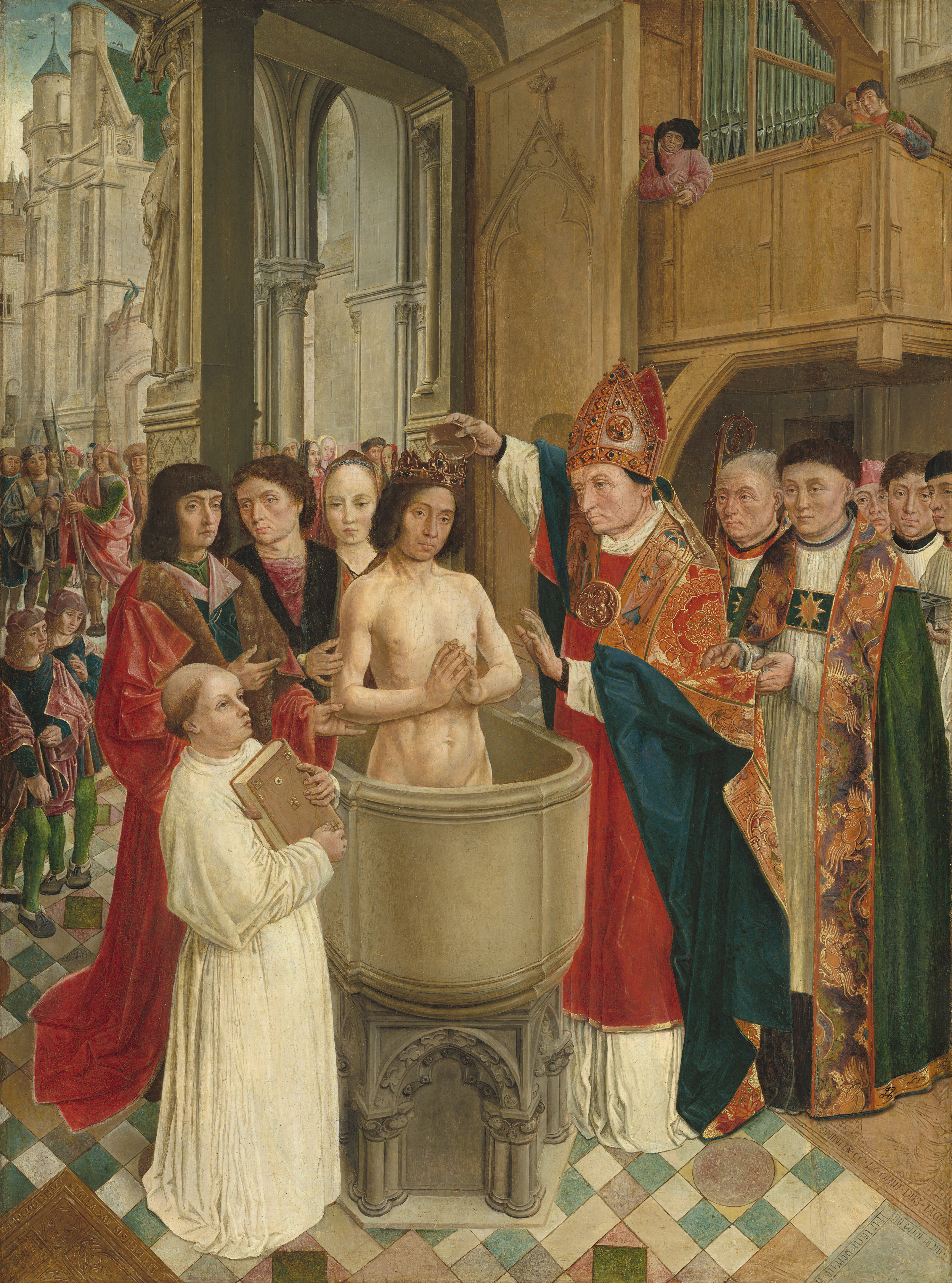
Saint Remigius baptizes Clovis I, by the Master of Saint Gilles, c. 1500 (National Gallery of Art, Washington)
Image from Wiki.
Remigius was the Bishop and Apostle of the Franks.
From James Keifer at the Lectionary:
A 1987 motion picture, "The Big Easy" (a nickname for the city of New Orleans), and a current (1996) television series of the same name based on it, have as the male lead a Cajun police detective named Remy McSwaine. In the first episode of the series (I am not sure of the film) we are informed that "Remy" is short for "Remington." I fear that this shows that the scriptwriters have not troubled to research Cajun culture. Remi is one of the three great national saints of France (the others are Denis (Dionysius) of Paris and Joan of Arc, or Joan the Maid (Jeanne la Pucelle)), and it is thoroughly natural for a Cajun to be named Remi. How is that for a topical introduction?
Well, James Kiefer, that's quite an introduction, especially for an old lady living in Cajunland. I love it.
Remi (Latin Remigius) was born about 438 and became bishop of Rheims about 460, at the remarkably young age of 22. (Both he and the city were named for his tribe, the Remi.) In his time, the Roman Empire and the Christian church were jointly faced with a serious practical problem -- the barbarian invasions.
Kiefer goes on to give a capsule history of the of the barbarian invasions and the dispute between the those who followed Athanasius' view that Jesus Christ was truly divine and those who followed Arius and believed that Jesus was the greatest of God's creatures. The Council of Nicea should have settled the matter because the bishops gathered gave overwhelming support to Athanasius' position. However, in the years ahead, despite the decision of the Council, political events worked to give the Arians the upper hand and Arianism spread.
Remegius was an Athanasian.
Then, along came the Franks, another barbarian tribe, led by Clovis, a pagan, who was married to Clotilda, a Christian. Keifer says:
His wife and Bishop Remi (remember him?) spoke to him about the Christian faith, but he showed no particular signs of interest until one day when he was fighting a battle against the Alemanni, and was badly outnumbered and apparently about to lose the battle. He took a vow that if he won, he would turn Christian. The tide of battle turned, and he won. Two years later, he kept his vow and was baptized by Remi at Rheims on Christmas Day, 496, together with about 3000 of his followers.
Clovis was converted to the Athanasian or orthodox or catholic faith. He brought in priests of the Athanasian persuasion, and thus the orthodox position eventually prevailed throughout Europe.
As Kiefer says:
The conversion of the Franks brought about the conversion of the Visigoths, and eventually (about 300 years later) the empire of Charlemagne and the beginning of the recovery of Western Europe from the earlier collapse of government and of city life under the impact of plague, lead poisoning, currency inflation, confiscatory taxation, multiple invasions, and the assorted troubles of the Dark Ages.
Descendents of Clovis and Clotilda, Bertha and Ethelburga, married the pagan Ethelbert, King of Kent, and the pagan Edwin, King of Northumbria, leading to their conversions, which helped the spread of Christianity to southeastern and northern England.
READINGS:
Psalm 135:13-21 or 103:1-4,13-18
1 John 4:1-6
John 14:3-7
PRAYER
O God, who by the teaching of your faithful servant and bishop Remigius turned the nation of the Franks from vain idolatry to the worship of you, the true and living God, in the fullness of the catholic faith; Grant that we who glory in the name of Christian may show forth our faith in worthy deeds; through Jesus Christ our Lord, who lives and reigns with you and the Holy Spirit, one God, for ever and ever.
UPDATE: I edited the information beneath the painting at the head of the post.