Sometimes I think we should bury all
our money in a hole & go back to
enjoying life again, he said. It'd
probably be a good idea to make a map
of where the hole was just in case it
didn't work out though.
From StoryPeople.
Sometimes I think we should bury all
our money in a hole & go back to
enjoying life again, he said. It'd
probably be a good idea to make a map
of where the hole was just in case it
didn't work out though.


By the way, Mimi, I was wondering if you would mind adding me to your prayer list, just because I feel rather unwell? I have been getting a nagging pain in the left side on and off for a few years now. I did get examined for it (ultrasound etc, and they put some tubing with a camera on it into my stomach to check it out), and they couldn't find anything, but it is getting worse, I think, and my digestive system is increasingly going haywire for no really good reason. I need to get it checked out again. It feels as if there is some kind of blockage or problem in my gut somewhere. I am a little worried. In fact if you wouldn't mind posting a prayer request at Wounded Bird I would be immensely grateful.

Millions of the moviegoers who made “The Social Network” the top box-office draw of the weekend saw an unflattering portrayal of Mark Zuckerberg, the co-founder and chief executive of Facebook.According to the articles in Slate and The New Republic, the movie is inaccurate in its portrayal of Zuckerberg, Harvard, and the founding of Facebook. People who know Mark Zuckerberg personally agree.
To many viewers, Mr. Zuckerberg comes off as a callow, socially inept schemer who misled fellow students who had wanted to build an online social network at Harvard and who also pushed out a co-founder of the company. With only a few exceptions — girlfriends and a prominent Silicon Valley venture capital firm — the names have not been changed to mask identities.
The film’s truthfulness, however, has been strongly questioned in forums like Slate, the online magazine, and The New Republic.
And that raises a question: how can filmmakers take liberties with the story of a living person, and does that person have any recourse if the portrayal upsets him? After all, many movies run a legal disclaimer in the credits that says, “Any resemblance to real persons, living or dead, is purely coincidental.”
....
When it comes to public figures, lawyers say, appropriating someone’s life story for a movie is not so different from telling such details in a news article or printed biography. Politicians have grown used to harsh onscreen treatment, having learned that there is a degree of latitude for inaccuracy and strong protection against libel suits.
Eugene Volokh, a professor at the University of California, Los Angeles, law school, said that if Mr. Zuckerberg sued and was declared a public figure, he would then “have to show that the filmmakers knew the statements were false, or were reckless about the possibility of falsehood.”

The Social Network I saw was a rote and deeply mediocre film, much weaker than the best work of its writer or director. How could I, who should have been sucked deep into that on-screen universe (Mark Zuckerberg was one of the first people I met in college; we lived a couple of rooms apart as freshmen), feel so impervious to the movie's "emblematic" pull?Of Zuckerberg, Heller says:
There was a sense in 2002 and 2003, in other words, that as a group of people on the verge of cultural maturity, we had little of our own with which to lay claim to the moment—besides, maybe, the social bonds and shorthand that arose from all being in this place together. That is the real beginning of Facebook's rise and the useful measure of Mark Zuckerberg's brilliance. What's often overlooked in recent talk of the Facebook founder's "robot" stiffness or bizarre, officious ideas about online privacy is what a canny and receptive cultural reader he was.Heller should know. And my concerns about online privacy at Facebook are antediluvian, if not worse. And here I thought I was one of the elders who was keeping up. Good-bye to all that.
In 2009, Aaron Sorkin (“Sports Night,” “The West Wing”) got (yes, the same word) the idea to write a script for a movie about this new social network. Here’s the important point: He made it. As with every one of his extraordinary works, Sorkin crafted dialogue for an as-yet-not-evolved species of humans—ordinary people, here students, who talk perpetually with the wit and brilliance of George Bernard Shaw or Bertrand Russell. (I’m a Harvard professor. Trust me: The students don’t speak this language.) With that script, and with a massive hand from the film’s director, David Fincher, he helped steer an intelligent, beautiful, and compelling film through to completion. You will see this movie, and you should. As a film, visually and rhythmically, and as a story, dramatically, the work earns its place in the history of the field.Was I so affected by the movie because I share somewhat in Sorkin's self-congratulatory contempt of Facebook? Because I view the website through the eyes of the old?
But as a story about Facebook, it is deeply, deeply flawed. As I watched the film, and considered what it missed, it struck me that there was more than a hint of self-congratulatory contempt in the motives behind how this story was told. Imagine a jester from King George III’s court, charged in 1790 with writing a comedy about the new American Republic. That comedy would show the new Republic through the eyes of the old. It would dress up the story with familiar figures—an aristocracy, or a wannabe aristocracy, with grand estates, but none remotely as grand as in England. The message would be, “Fear not, there’s no reason to go. The new world is silly at best, deeply degenerate, at worst.”
THE Catholic Group in the General Synod was described on Wednesday morning as “incandescent” about Tuesday’s announcement of the membership of the group that will prepare the draft code of practice to accompany the women-bishops Measure.
The drafting group was set up by the House of Bishops, which has the responsibility of presenting a draft code to the General Synod.
Prebendary David Houlding, a leading member of the Catholic Group, said on Wednesday: “We are all so angry and dismayed. It’s clear from the compilation of this group that there is to be no honoured place in the Church of England for traditionalists — that we are not wanted. This group is set up to fail before it begins. It’s one [Bishop Martin Warner] against seven.
“To put two members of the revision committee and no members of the Catholic Group — the audacity of it. I think it’s a disaster.”
TWO Church of England flying bishops have denied reports that they will resign in order to join the Roman Catholic Ordinariate before the end of the year.
The Bishop of Ebbsfleet, the Rt Revd Andrew Burnham, and the Bishop of Richborough, the Rt Revd Keith Newton, both Provincial Epis copal Visitors, were said last week to have decided to leave the C of E and accept the Pope’s invitation to join the Ordinariate within the Roman Catholic Church.
....
The two bishops will be on study leave from tomorrow until the end of December.
The report also said that Bishop Burnham favoured joining the Ordinariate, and was not optimistic about the new Society of St Wilfrid and St Hilda for Catholic clergy and laity (News, 1 October).
Describing the society’s purpose, Bishop Ford said that it “had been worked up in embryo to be offered as an option so that those who could not, in conscience, see a way forward in the Ordinariate would have some sort of identity”. It “is not competing with the Ordinariate”, he said, and it would “not be another club or pressure group”, but “a common life”.
....
The Revd Ivan Aquilina, Vicar of St John the Baptist, Sevenoaks, who attended the sacred synod, said: “So far, what the aims and objectives are is not clear, so, while some are joining it, already others will want to wait and see. . . The society may or may not secure some sort of provision or a stronger code of practice. It may also be an honoured vehicle for those who, for personal or ecclesial reasons, cannot be part of the Catholic family.”
PRIMATES from the Global South are contemplating a boycott of the next Primates’ Meeting because the US Presiding Bishop, Dr Katharine Jefferts Schori, will be present.
The Archbishop of the Indian Ocean, the Most Revd Ian Ernest, has confirmed that he will not attend the meeting, due to take place in Dublin, 25-31 January.
....
Dr Jefferts Schori has already confirmed that she will attend the meeting.
Primates of the Global South are expected to meet this month to discuss whether they will refuse en masse to attend.
....
They [Global South primates] are being encouraged to attend by, among others, the president of the American Anglican Council, the Rt Revd David Anderson, a suffragan bishop within the Convocation of Anglicans in North America, who has posted a letter on a website urging traditionalist bishops to go to the meeting.
In a bizarre suggestion, he advises that Dr Jefferts Schori be shut out of the room, or removed “by force of numbers” if she attends. If Dr Williams objects to this, the meeting could go ahead in a separate room without him.
....
“In the above case, if Dr Williams did not go along with Jefferts Schori’s exclusion, then I would suggest having the next-door meeting with out him. I just don’t believe staying home from the field of battle helps win a war over the truth and nature of Christianity within Anglicanism.”
Blessings and Peace in Christ Jesus,
The Rt. Rev. David C. Anderson, Sr.
President and CEO, American Anglican Council

If "The Social Network" was a Facebook page, I'd have no choice but to "like" it -- but only because there's not a "love" button, or a "totally gaga about" button.
David Fincher's smartly written, expertly told chronicling of the dawn of the Facebook era -- and, more subtly, of the impact it's had on the devolution of humankind as a social animal -- is just that compelling, that engrossing, that hard to resist.
Kind of like a certain website.
“The Social Network,” directed by David Fincher and written by Aaron Sorkin, rushes through a coruscating series of exhilarations and desolations, triumphs and betrayals, and ends with what feels like darkness closing in on an isolated soul. This brilliantly entertaining and emotionally wrenching movie is built around a melancholy paradox: in 2003, Mark Zuckerberg (Jesse Eisenberg), a nineteen-year-old Harvard sophomore, invents Facebook and eventually creates a five-hundred-million-strong network of “friends,” but Zuckerberg is so egotistical, work-obsessed, and withdrawn that he can’t stay close to anyone; he blows off his only real pal, Eduardo Saverin (Andrew Garfield), a fellow Jewish student at Harvard, who helps him launch the site.
Soon afterward, he (Zuckerberg) came up with Facemash, where users looked at looked at photographs of two and clicked a button to note who they thought was hotter, a kind of sexual-playoff system. It was quickly shut down by the school administration.
Zuckerberg's business model depends on the shifting notions of privacy, revelations, and sheer self-display. The more that people are willing to put online, the more money his site can make from advertizers.
Zuckerberg’s ultimate goal is to create, and dominate, a different kind of Internet. Google and other search engines may index the Web, but, he says, “most of the information that we care about is things that are in our heads, right? And that’s not out there to be indexed, right?” Zuckerberg was in middle school when Google launched, and he seems to have a deep desire to build something that moves beyond it. “It’s like hardwired into us in a deeper way: you really want to know what’s going on with the people around you,” he said.
....
For this plan to work optimally, people have to be willing to give up more and more personal information to Facebook and its partners. Perhaps to accelerate the process, in December, 2009, Facebook made changes to its privacy policies. Unless you wrestled with a set of complicated settings, vastly more of your information—possibly including your name, your gender, your photograph, your list of friends—would be made public by default. The following month, Zuckerberg declared that privacy was an evolving “social norm.”
The backlash came swiftly. The American Civil Liberties Union and the Electronic Privacy Information Center cried foul. Users revolted, claiming that Facebook had violated the social compact upon which the company is based. What followed was a tug-of-war about what it means to be a private person with a public identity. In the spring, Zuckerberg announced a simplified version of the privacy settings.
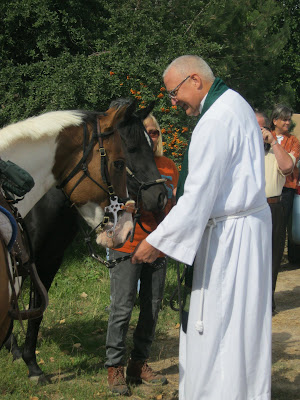
Me (Paul the BB), rejoicing in Chica and Tuxedo, my friend Jan's horses, at San Gabriel, Corrales.
May your abundant ✠ blessing rest upon these creatures who are our companions in the journey of life. Amen.
Let us also remember the less fortunate creatures of this world.
Hear our humble prayer, O God, for our friends the animals, especially for those animals that are suffering; for all that are overworked and underfed and cruelly treated; for all wistful creatures in captivity that beat against the bars; for any that are hunted or lost or deserted or frightened; for all that are in pain or dying; for all that must be put to death. We entreat for those who deal with them a heart of compassion, gentle hands, and kind words; that they may share thus the blessing of the merciful. For you, O lord, will save both human and beast, and great is your loving-kindness. Amen.
--the BB
I am still collecting my thoughts about the appointment, which, I must admit, left me kind of gobsmacked. Not because Christopher is unfit to be Bishop of Southwark, because he is eminently fit. It is out of the ordinary for a suffragan bishop to be appointed Bishop of the Diocese in which he was suffragan, at least in the Church of England. Other clergy in the diocese have remarked that they thought he might get Truro (before that was filled). So appointing him to Southwark was an unexpected pleasure.


