Monday, May 19, 2008

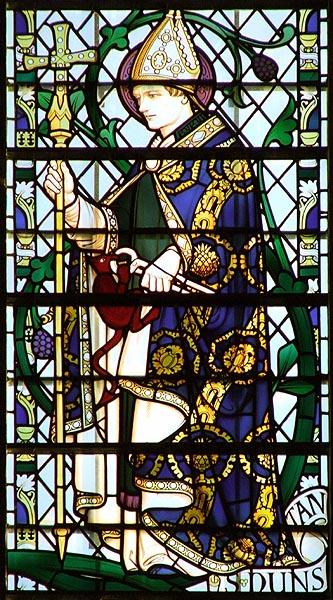
Feast Day Of St. Dunstan Of Canterbury


Image from Early British Kingdoms.

Dunstan was born near Glastonbury in the southwest of England about the year 909, ten years after the death of King Alfred. During the Viking invasions of the ninth century, monasteries had been favorite targets of the invaders, and by Dunstan's time English monasticism had been wiped out. In its restoration in the tenth century, Dunstan played the leading role.
....

(Glastonbury is one of the oldest Christian sites in England, and is associated in legend with King Arthur and his Court, with Joseph of Arimathea, and with other worthies. It has been said that the Holy Grail, the chalice of the Last Supper, is hidden somewhere near Glastonbury.) Under Dunstan's direction, Glastonbury became an important center both of monasticism and of learning. The next king, Edred, adopted Dunstan's ideas for various reforms of the clergy (including the control of many cathedrals by monastic chapters) and for relations with the Danish settlers. These policies made Dunstan popular in the North of England, but unpopular in the South.

Edred was succeeded by his sixteen-year-old nephew Edwy, whom Dunstan openly rebuked for unchastity. The furious Edwy drove Dunstan into exile, but the North rose in rebellion on his behalf. When the dust settled, Edwy was dead, his brother Edgar was king, and Dunstan was Archbishop of Canterbury. The coronation service which Dunstan compiled for Edgar is the earliest English coronation service of which the full text survives, and is the basis for all such services since, down to the present. With the active support of King Edgar, Dunstan re-established monastic communities at Malmesbury, Westminster, Bath, Exeter, and many other places. Around 970 he presided at a conference of bishops, abbots, and abbesses, which drew up a national code of monastic observance, the "Regularis Concordia". It followed Benedictine lines, but under it the monasteries were actively involved in the life of the surrounding community. For centuries thereafter the Archbishop of Canterbury was always a monk.


In addition, Dunstan was a musician, a bell maker, and a painter.

From the The Lectionary.

Readings:

Psalm 57:6-11 or 33:1-5,20-21
Ecclesiasticus 44:1-7
Matthew 24:42-47

PRAYER

Almighty God, who raised up Dunstan to be a true shepherd of the flock, a restorer of monastic life and a faithful counsellor to those in authority: give to all pastors the same gifts of your Holy Spirit that they may be true servants of Christ and all his people; through Jesus Christ our Lord, who lives and reigns with you and the Holy Spirit, one God, now and for ever. Amen

This is, for the most part, a recycling of my post from last year on the feast day. The glass is lovely, isn't it? The comments from last year are fascinating, if you'd care to read them.


In the comments, Lapin references this small self-portrait, which is from the website of the St. Edward the Martyr Orthodox Brotherhood.

Mary Clara posted these lovely words in the comments. I believe that they are worthy of being brought into the light because they are so very right and true. My decision to quote her has nothing to do with her words being flattering to me - not in the least. Truly.

Mimi, I am very big on the priesthood of all the baptized, which can take so many forms, from emptying bedpans to doing biblical scholarship. In the past I think most lay ministry has been relatively private and even inarticulate. One of the great things about the internet and the blogosphere is that many more of us in the lay order can readily join in the theological conversation, offer homilies or reflections on the daily lectionary, post worship materials, comment on and issues worthy of attention, and so on. We are finding our voices. Our ordained clergy and bishops are our 'specialists' with their unique vocation and training and their sacramental role. In terms of preaching and teaching, they are like the paid professional soloists in many church choirs who help maintain the level of a parish's liturgical music. Backing them up are the unpaid volunteer singers, many of them also gifted and well-trained, who make up the bulk of the choir. Finally there are those who swell the sound from the congregation. Not a perfect analogy, but you see my point: All should take part, and together we should be able to make fine music! Our clergy in their lonely and risky work (see Elizabeth Kaeton's latest post as well as Lauren Gough's recent comments on several blogs) should be surrounded by a host of supportive voices (and under 'support' I include honest debate and disagreement, as well as poking fun) and by many writing hands sharing the work.

This is a time for all hands to be on deck, both in our beloved church and inour beloved country, and you, Mimi, are doing your part!


Thank you, Mary Clara!

Mass Graves Uncovered In South Korea

From the Associated Press:

Grave by mass grave, South Korea is unearthing the skeletons and buried truths of a cold-blooded slaughter from early in the Korean War, when this nation's U.S.-backed regime killed untold thousands of leftists and hapless peasants in a summer of terror in 1950.

With U.S. military officers sometimes present, and as North Korean invaders pushed down the peninsula, the southern army and police emptied South Korean prisons, lined up detainees and shot them in the head, dumping the bodies into hastily dug trenches. Others were thrown into abandoned mines or into the sea. Women and children were among those killed. Many victims never faced charges or trial.

....

Hundreds of sets of remains have been uncovered so far, but researchers say they are only a tiny fraction of the deaths. The commission estimates at least 100,000 people were executed, in a South Korean population of 20 million.

That estimate is based on projections from local surveys and is "very conservative," said Kim. The true toll may be twice that or more, he told The Associated Press.


The South Korean and US governments kept the information secret for over half a century, and only in the 1990s did the word begin to leak out.

The declassified record of U.S. documents shows an ambivalent American attitude toward the killings. American diplomats that summer urged restraint on southern officials — to no obvious effect — but a State Department cable that fall said overall commander Gen. Douglas MacArthur viewed the executions as a Korean "internal matter," even though he controlled South Korea's military.

There is no such thing as a good war.

A Sermon For Trinity Sunday

From Rmj at Adventus.

2 Corinthians 13:11-14

Finally, brothers and sisters, farewell. Put things in order, listen to my appeal, agree with one another, live in peace; and the God of love and peace will be with you. Greet one another with a holy kiss. All the saints greet you.

The grace of the Lord Jesus Christ, the love of God, and the communion of the Holy Spirit be with all of you.


From the conclusion of the sermon:

Greet one another with a holy kiss. What would it be like to do that today? Greet everyone here in church that way? Or on the street? In the store? Over coffee? All the saints would greet you, but what would everyone else say? Would the grace of the Lord Jesus Christ, the love of God, and the communion of the Holy Spirit be with you, even as your friends decided you must be crazy? Even as your enemies in church, in life, decided you had gone insane? I mean, if everybody did that, if just ever Christian did that, what kind of world would this be?

Yes. Precisely. What kind of world would this be? We were told to go and make a community, disciples of all nations, meaning followers no matter who they were: no matter race or national origin or place or language. We were told to find and build a community, and promised that Jesus would be with us always, to the end of the age. And what community have we built? What support have we given each other for the hard work of faith, of believing, of loving our enemy and seeing that Creation is indeed good? If Christ came in the doors today to ask us, what would we say?

Maybe we could say we were about to get to it; that we’ll get to it right away. That this Trinity Sunday, the day we honor Father, Son, and Holy Ghost; Creator, Redeemer, and Sanctifier, we set aside as the day of remembrance that we are together in Christ, and that the work to be done we can do together: that all the saints greet us, and guide us on our way. If we would just greet each other in peace, and accept their teaching, and accept their community, and God’s grace.

Much to be done; and we can begin today. We can begin with prayer, and study. There is a cloud of witness around us, ready to be our guide. Nothing is left to us alone. They are here; we can ask them. God is with us. It is good.

Amen.


Indeed! What kind of a world would it be if we took the words into our hearts and lived like that? What kind of Episcopal Church would we have? What kind of Anglican Communion?

Click on the link at the beginning of the post to read the entire sermon.

For Paul, The BB


Harry James and his orchestra with singer, Helen Forest.

Thank you, Paul, for your wonderful post on my beloved city of New Orleans. He has maps. He has a video of the destroyed Lower Ninth Ward. He has music videos, one with Harry Connick, Jr. and Branford Marsalis, and more.

Sunday, May 18, 2008

Shield Of TheTrinity


Arms attributed to St. Michael in the 15th century.

"The Father is God"
"The Son is God"
"The Holy Spirit is God"
"God is the Father"
"God is the Son"
"God is the Holy Spirit"
"The Father is not the Son"
"The Son is not the Father"
"The Father is not the Holy Spirit"
"The Holy Spirit is not the Father"
"The Son is not the Holy Spirit"
"The Holy Spirit is not the Son"

Taken from The Athanasian Creed.

Julian of Norwich

Just as the joyful Trinity
created all things
out of nothing,

So also this same blessed Trinity
will make well
all that is not well.

-------

Our soul is trinitarian
like to the
uncreated Trinity.

It is known
and loved
from without beginning
and in its creation
oned to the Creator.


Alas! The feast is nearly ended - indeed, has already ended for some. I'm sorry to be late.

Shortened explanation of the shield and image from Wiki.

Words of Julian of Norwich from Meditations With Julian of Norwich by Brendan Doyle.

"A City Of The Dead"

Most people remember where they were when the levees broke in New Orleans. I was in Trinidad at the time. My daughter who lives in Dallas, Texas, called a few days later to say that many of her cousins were trapped on their way out of Texas a few days later when many parts of Texas were threatened by another violent storm. Apart from very long lines of traffic along the highway for several hours (it seemed as though it were a gigantic parking lot) they escaped the fury of this natural force.

Last weekend Louis Lee Sing and Tony Lee, two of my dearest friends and I attended the New Orleans Jazz Fest. Although I went to hear jazz I took the time out to explore the city. I was amazed by the beauty and mystery of the city.

After I arrived at Louis Armstrong Airport, I took a cab to Crown Plaza Astor where I stayed. In the cab, I was assailed by Johnny Horton's rendition of Jimmy Driftwood's "The Battle of New Orleans." It is a song with which I was familiar. Recorded in 1958, it became a hit at the end of the nineteen fifties. It re-imagined the Battle of New Orleans, the final battle in the War of 1812.

Listening to the lyrics, I could well imagine what the battle felt like. The lyrics proclaimed: "Well, in eighteen and fourteen we took a little trip/along with Colonel Jackson down the mighty Mississip./ We took a little bacon and we took a little beans,/ And we caught the bloody British near the town of New Orleans./ We fired our guns and the British kept a'comin./ There wasn't nigh as many as there was a while ago./We fired once more and they began to runnin'/ down the Mississippi to the Gulf of Mexico."

And running some of them did all the way to Trinidad where they settled in Princes Town, Trinidad. In fact, between 1815 and 1816, over seven hundred free Black Americans who fought on the British side of the war were given refuge in Trinidad. These free Blacks became the first inhabitants of the company villages. If I am not mistaken, Prime Minister Patrick Manning may be a descendant of these Free Blacks.

New Orleans looked like any other West Indian town. With its mixtures of people and its zest for life Bourbon Street resembled any Port of Spain street on Carnival Monday night. There were more live bands on this street that anywhere I know about and the liquor flowed copiously. A friend remarked: "You can regard New Orleans as the most northerly city of the Caribbean; Port of Spain as the most southerly." It represented the coming together of explorers and pirates, Voodoo Queens and Carnival (Mardi Gras) Kings, African slaves and European aristocrats.

I was interested in the Voudou aspect of things. It was introduced into New Orleans by slaves from the West Indies. As fate would have it, on Friday evening we went out to Red Fish Grill on Bourbon Street to get a taste of New Orleans' Creole cuisine. To my amazement one of the waiters at the restaurant was a direct descendant Marie Laveau, a Voudou Priestess, of New Orleans fame. One account described her as having a combination of "spiritual power, clairvoyance, healing abilities, beauty, chrisma, showmanship, intimidation, and shrewd business sense that enabled her to assume leadership of a multicultural religious community and accumulate wealth and property."

Such a description reminded me of our own Mother Gerald in Tacarigua, a Shango priestess, who claimed to have mystical powers. All of us in the village paid her the necessary respects and my grandmother was one of her faithful followers. Whether in New Orleans or in Tacarigua, these seer-women played an important role in keeping the community together and aspect of our African tradition alive.

No visit to New Orleans would be complete without a visit to a "City of the Dead," the cemeteries of New Orleans. Since parts of the city are actually below sea level, New Orleans had to construct a system of tombs above the ground to honor their dead. These tombs looked like live vaults that sough to maintain the sanctity of those who passed away. They resembled miniature cities with family tombs arranged very neatly and walkways to match.

A visit to the city of the dead prepared me for my visit to the 9th Ward where Hurricane Katrina had struck with all of her fury. That expanse of land lay abandoned. No one seemed to care for the people who had lost all of their worldly possessions. A federal government that had spent over 500 billion dollars on a War in Iraq seemed indifferent to victims of Katrina whose belongings (or what was left of them) were strewn all over the place.

The 9th War[d] reminded one of the cities of the dead. Somehow the city of the dead looked as though it were better cared for than the abandoned remains of Ward 9. Maybe only God that can put a hand to assist these abandoned victims of Hurricane Katrina. I hope it does not take too long.


Posted with thanks to:

Dr. Selwyn R. Cudjoe, Professor
President, NAEAP
Africana Studies
Wellesley College

Professor Cudjoe graciously permitted me to quote his article in its entirety. I'm immensely grateful to him for his affection and concern for New Orleans, the home of my heart, and for his reminder of the historical connection of the city with the islands of the Caribbean. New Orleans history and culture are rich and greatly diverse. Whenever I visited the islands, the styles of the buildings in the old sections of the towns seemed quite familiar to me.

Dr. Cudjoe says of the New Orleans, "I was amazed by the beauty and mystery of the city." And so am I, even with the familiarity growing up there. Whenever I return, I am amazed once again, having lived elsewhere for over 40 years.

I remember where I was upon hearing of the levee breaches. We were at our small farm northwest of Baton Rouge, all 15 of us in two small farmhouses, with five dogs and three cats, having evacuated from Thibodaux, Houma, and New Orleans. On a grainy TV screen powered by a generator and rabbit ears - for we had lost power there, too - we first heard that New Orleans had "dogded a bullet" from Katrina, that the city had fared pretty well. And then the levees broke, in Lakeview, in Gentilly, in the Lower Ninth Ward, and in St. Bernard Parish and the waters came, the federal flood, due to faulty levees that did not do the job that they were constructed to do. Dr. Cudjoe's comparison of the cemeteries to the Lower Ninth Ward is apt, as is his reflection that the dead were cared for better than the living.

No help came for several days, and then it began to trickle in, slowly, oh so slowly, even today coming much too slowly. But for the sheer determination of the citizens of New Orleans and the help of volunteers and gifts from all over the world, what progress that has been made would have been much less. And the war grinds on, the killing fields devouring money in amounts that our imaginations can't take in. And so it goes.

Dr. Cudjoe's homepage is here.

H/T to Rmj at Adventus for the link to Professor Cudjoe's article.

Saturday, May 17, 2008

The Insanity Of The Iraq War and "Appeasement"

From James Carroll at the Boston Globe:

Insanity is defined as repeating one mistaken action again and again, each time expecting a better result that never comes. Prime example: the United States in Iraq. Washington perceived a weapons of mass destruction threat from Saddam Hussein, but instead of responding with diplomacy - internationally coordinated weapons inspections - it went to war. When Saddam Hussein was toppled, the initiative should have passed from the Pentagon to a State Department-led program of stabilization and reconstruction, but instead a crudely violent military occupation was begun. Diplomacy was once again rejected.
....

Let's call this repeated insanity the mistake of "supermilitarism," choosing war over diplomacy, and expecting order to follow, instead of chaos. The mistake was made at the beginning, in the middle, and is being repeated now, in what should be the end. The mistake is so deeply rooted in American structures of imagination, economy, and government that it isn't even perceived as a mistake by those in power. And it threatens the future as much as it burdens the past.
....

The occupation is the mistake that keeps on taking.

The healing of Iraq would be far more readily achieved by an American acknowledgment of failure, and by the engagement of other nations that such an acknowledgment would immediately invite. But insanely holding on in Iraq until Washington can claim something like "victory" means that this globally oriented geo-political ambition - America's standing in the world - is being bought at the price of Iraqi blood.


And now Barack Obama is being Swift-Boated by the president himself in a foreign country and by John McCain for wanting to try diplomacy with "rogue nations" before launching wars. Remember Bush's Axis of Evil, Iraq, Iran, and North Korea? Well, according to CNN, Bush is negotiating with North Korea:

WASHINGTON (AP) -- The United States said Friday it has reached a deal with North Korea to provide 500,000 metric tons of food aid over the coming year to the closed-off communist nation.

The Bush administration says the aid is unrelated to its nuclear disarmament deal with Pyongyang, although both have involved an unusual intensity of U.S. diplomacy with a nation President Bush once included as part of a rhetorical "axis of evil."


Obama is being accused of "appeasement" by ignorant or deceptive people who do not know or care what the word means. Using diplomacy with leaders of other nations is NOT appeasement. Will the American people buy this ugly smear? We shall see.

Drug Dealer Calls Cops For Help

From the Advocate:

HAMMOND — Deputies arrested a Hammond man Friday after he allegedly called to report that someone stole the drugs he was selling, the Tangipahoa Parish Sheriff’s Office reported.

Cedrick Riley Sr., 23, 42336 E. Pleasant Hill Road Extension, told deputies that he was trying to sell drugs when his would-be customers hit him across the head with a gun, tied him up and robbed him of his illicit merchandise near a gas station on University Avenue and Puma Drive in Hammond, said a statement from the Sheriff’s Office.


The sheriff's office found two outstanding warrants against Riley. Tough luck.

Note to Cedrick: Next time suck it up.

Still Not Ready For The Olympics


As you slip, don't crack your head, hurt your back, or break your arm or leg. Go down gently.


Please no hands over mouths. Keep mouths visible at all times, to show that you are not conversing, or spitting, or spewing spittle while you converse.


It's quite easy, even if you don't speak Chinese.


No smiling, laughing, or happy expressions which might suggest that you are having fun.

(For the record, the lame captions under the signs are mine.)

Thanks to Doug for the signs.

"That's How The Light Gets In..."


The video nobody "got" at Filmapalooza the sequel. Not that there was anything to get, but it's much more fun if I make myself sound like a misunderstood artist. Anyway, this is our interpretation of Leonard Cohen's "Anthem", which is a lovely song. Enjoy.
Dylan Wendell Cunningham and Caitlin Davidson.

Lifted from Ann at What the Tide Brings In.

Ann says:

"A video for Pentecost. How are we cracked by life? How can the Spirit get in?"