Sunday, January 18, 2009

Of Course, The Haters Were There


From the Huffington Post:

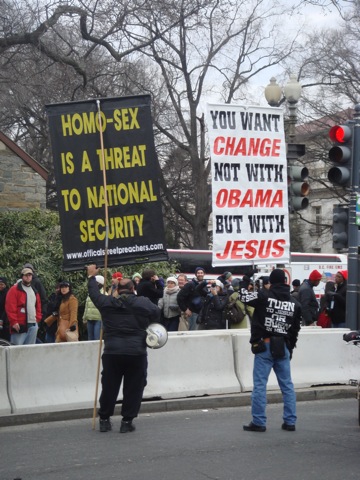
Appearing at the primary public entrance to the pre-Inaugural concert at the Lincoln Memorial, representatives from a group calling itself "Brother Ruben and the Official Street Preachers" protested openly-gay Episcopal Gene Robinson's participation in the event.

With a diverse and otherwise joyous crowd of adults and children of all ages streaming by, the three protest participants shouted about hate, hell and "homo-sex" - using a megaphone to assert that "homosexuals are eternally damned" and "Jesus doesn't love homosexuals."


Read the rest of the post and check out Brother Ruben's website. I won't link to it, but there's a link in the HP piece.

Bishop Gene Robinson's Prayer

By The Rt. Rev. V. Gene Robinson, Episcopal Bishop of New Hampshire

Opening Inaugural Event
Lincoln Memorial, Washington, DC
January 18, 2009

Welcome to Washington! The fun is about to begin, but first, please join me in pausing for a moment, to ask God’s blessing upon our nation and our next president.

O God of our many understandings, we pray that you will…

Bless us with tears – for a world in which over a billion people exist on less than a dollar a day, where young women from many lands are beaten and raped for wanting an education, and thousands die daily from malnutrition, malaria, and AIDS.

Bless us with anger – at discrimination, at home and abroad, against refugees and immigrants, women, people of color, gay, lesbian, bisexual and transgender people.

Bless us with discomfort – at the easy, simplistic “answers” we’ve preferred to hear from our politicians, instead of the truth, about ourselves and the world, which we need to face if we are going to rise to the challenges of the future.

Bless us with patience – and the knowledge that none of what ails us will be “fixed” anytime soon, and the understanding that our new president is a human being, not a messiah.

Bless us with humility – open to understanding that our own needs must always be balanced with those of the world.

Bless us with freedom from mere tolerance – replacing it with a genuine respect and warm embrace of our differences, and an understanding that in our diversity, we are stronger.

Bless us with compassion and generosity – remembering that every religion’s God judges us by the way we care for the most vulnerable in the human community, whether across town or across the world.

And God, we give you thanks for your child Barack, as he assumes the office of President of the United States.

Give him wisdom beyond his years, and inspire him with Lincoln’s reconciling leadership style, President Kennedy’s ability to enlist our best efforts, and Dr. King’s dream of a nation for ALL the people.

Give him a quiet heart, for our Ship of State needs a steady, calm captain in these times.

Give him stirring words, for we will need to be inspired and motivated to make the personal and common sacrifices necessary to facing the challenges ahead.

Make him color-blind, reminding him of his own words that under his leadership, there will be neither red nor blue states, but the United States.

Help him remember his own oppression as a minority, drawing on that experience of discrimination, that he might seek to change the lives of those who are still its victims.

Give him the strength to find family time and privacy, and help him remember that even though he is president, a father only gets one shot at his daughters’ childhoods.

And please, God, keep him safe. We know we ask too much of our presidents, and we’re asking FAR too much of this one. We know the risk he and his wife are taking for all of us, and we implore you, O good and great God, to keep him safe. Hold him in the palm of your hand – that he might do the work we have called him to do, that he might find joy in this impossible calling, and that in the end, he might lead us as a nation to a place of integrity, prosperity and peace.

AMEN.


From the Episcopal Café.

H/T to Ann.

Bishop Gene's Schedule

Elizabeth Kaeton at Telling Secrets posted Bishop Gene's schedule while he's in Washington, DC. The bishop says:

1. I will be blogging from Washington, using my summer's blogspot: Canterbury Tales From the Fringe.
Perhaps this should be renamed "Tales from Closer to the Center" but I didn't have time!


Read the rest at Elizabeth's blog.

Saturday, January 17, 2009

Obama


The Barack Obama family on the steps of the Lincoln Memorial last Saturday

Tonight, after we came home from the play, I viewed parts of the videos of President-elect Barack Obama's train ride from Philadelphia, Pennsylvania, to Washington, DC. The adjectives which came to mind as I watched him give his speeches were: poised, self-assured, graceful, magnetic, at ease. I could go on.

And then, I remember Counterlight's words, "Never fall in love with a politician". Well, maybe for only a few days? Would that be all right?

Click And Click

Being Peace posted two videos, Born Again American and A Long Way that are worth a look. Click on over there to see.

A Father's Cry

From Juan Cole:

The father of the dead little girls, Dr. Izz el-Deen Aboul Aish, appears to have been a sort of an Arab "Dr. Sanjay Gupta" who came on Israeli television frequently. He was about to do an interview on Israeli television when the word reached him of the atrocity against his family. His wife had earlier died of cancer, so his children were all he had left. He commuted to Tel Aviv from Gaza and told the girls to sleep near the stone walls to stay safe in his absence.


Doctor Izz el-Deen Aboul Aish, 2009-01-16, Israel Channel 10

I'm posting this video to demonstrate the reality of an Arab doctor's gut-wrenching grief upon hearing of the deaths of his daughters and niece in Gaza. My intention is not to stir controversy. Keep in mind that the video is a clip from an Israeli TV station.

A fair warning: If comments to this post get ugly, I shall close the comments down.

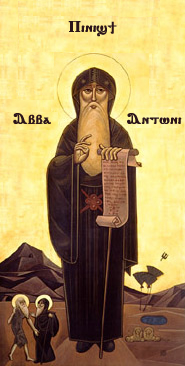
Feast Day Of Antony Of Egypt


Before the conversion of the Emperor Constantine in 312 AD, back in the days when Christianity was still a persecuted religion, the act of becoming a Christian involved turning one's back on the pursuit of security, of fashionable prestige and popularity, of success as the term is widely understood.

James Kiefer at the Lectionary.

I wonder whether I would choose to be a Christian if I faced persecution. I hope that I would.

Readings:

Psalm 91:9-16 or 1
1 Peter 5:6-10
Mark 10:17-21

As he was setting out on a journey, a man ran up and knelt before him, and asked him, ‘Good Teacher, what must I do to inherit eternal life?’ Jesus said to him, ‘Why do you call me good? No one is good but God alone. You know the commandments: “You shall not murder; You shall not commit adultery; You shall not steal; You shall not bear false witness; You shall not defraud; Honour your father and mother.” ’ He said to him, ‘Teacher, I have kept all these since my youth.’ Jesus, looking at him, loved him and said, ‘You lack one thing; go, sell what you own, and give the money to the poor, and you will have treasure in heaven; then come, follow me.’

"Jesus, looking at him, loved him...." I find that it's easy to skip over the words, as they're almost a throwaway phrase, but how fraught they are.

PRAYER

O God, who by your Holy Spirit enabled your servant Antony to withstand the temptations of the world, the flesh, and the devil: Give us grace, with pure hearts and minds, to follow you, the only God; through Jesus Christ our Lord, who lives and reigns with you and the Holy Spirit, one God, for ever and ever.

Image from Wiki.

Friday, January 16, 2009

"The McDonaldisation Of Church Learning"


In his post titled "Church and Education" Pluralist Speaks writes:
So much that passes for church learning I must criticise. Alpha, for example, is the McDonaldisation of church learning: bite size ready answers for whatever questions may arise. It is a recruiting method (or a recycling method, really). It is marketed and carries power connotations: power and influence for Holy Trinity Brompton, power and influence for generally one kind of Christianity delivered with a copyright notice. It's capitalism in religion. It is also lazy teaching and learning, a sort of unwrapped national curriculum of sectional Christianity.
Very well spoken. It's surely an apt description of my experience of Alpha, although I could not have put it so well. I disliked the course rather intensely.

Read the rest of Pluralist's post. He describes his model of what church education should be. I find little there with which to disagree.

That's Pluralist's self-portrait up there.

A Place I Want To Visit In England


Rievaulx Abbey

"Pour into our hearts, O God, the Holy Spirit's gift of love, that we, clasping each the other's hand, may share the joy of friendship, human and divine, and with your servant Aelred draw many to your community of love; through Jesus Christ the Righteous, who lives and reigns with you, in the unity of the Holy Spirit, one God, now and forever."

Prayer attributed to Aelred of Rievaulx

Aelred was born in 1109 at Durham, and was sent to the Scottish court for an education that would ensure his future as a noble and courtier. He succeeded, to the extent of being made Master of the Household of the King of Scotland. Nevertheless, he found success at the court of an earthly king unsatisfying, and at the age of 24 he entered the Cistercian monastery at Rievaulx in Yorkshire. Bernard of Clairvaux encouraged him to write his first work, The Mirror of Charity, which deals with seeking to follow the example of Christ in all things. In 1147 he became abbot of Rievaulx, a post which he held until his death of kidney disease twenty years later at the age of 57.

From James Kiefer at the Lectionary.

I love ruins, especially ruins of sacred spaces. I'll never forget my visit to Glendalough Abbey, St. Kevin's monastery, in Ireland. While I was there, I experienced a sense that I was on holy ground and an almost physical presence. Over the centuries, many prayers were prayed there, and perhaps what I felt was the lingering presence of the prayers and of all the saints who prayed there.

Earlier in the week, I wanted to post on the Feast Day of Aelred, but I didn't have time. I wanted to send blessings and good wishes to Prior Aelred of St. Gregory's Abbey in Three Rivers, Michigan, on the feast day of his namesake, but I didn't do that either.

Prior Aelred, if you happen to pass by, a belated Blessed and Happy St. Aelred's Feast Day!

UPDATE: I visited Rievaulx Abbey in March 2009. It's a lovely and holy place.
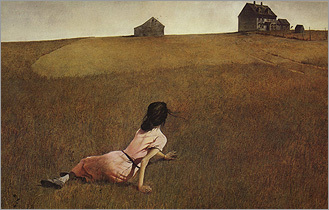
R. I. P. Andrew Wyeth


From the New York Times:

Andrew Wyeth, one of the most popular and also most lambasted artists in the history of American art, a reclusive linchpin in a colorful family dynasty of artists whose precise realist views of hardscrabble rural life became icons of national culture and sparked endless debates about the nature of modern art, died Friday at his home in Chadds Ford. He was 91.
....

Because of his popularity, a bad sign to many art world insiders, Wyeth came to represent middle-class values and ideals that modernism claimed to reject, so that arguments about his work extended beyond painting to societal splits along class, geographical and educational lines. One art historian, in response to a 1977 survey in Art News magazine about the most underrated and overrated artists of the century, nominated Wyeth for both categories.


He was popular, therefore he could not possibly be a good painter?

As John Updike said, “In the heyday of Abstract Expressionism, the scorn was simple gallery politics; but resistance to Wyeth remains curiously stiff in an art world that has no trouble making room for Photorealists like Richard Estes and Philip Pearlstein and graduates of commercial art like Wayne Thibauld, Andy Warhol, and for that matter, Edward Hopper.”

I'm not ashamed to say that I liked his paintings, especially "Christina", pictured above.

Wyeth had seen Christina Olson, crippled from the waist down, dragging herself across a Maine field, “like a crab on a New England shore,” he recalled. To him she was a model of dignity who refused to use a wheelchair and preferred to live in squalor rather than be beholden to anyone. It was dignity of a particularly dour, hardened, misanthropic sort, to which Wyeth throughout his career seemed to gravitate.

Misanthropic? Not at all. Wyeth painted Christina with dignity. How is that misanthropic?

I liked the much reviled Helga paintings, too. The writer of this piece calls them "soft core renditions". What are the chances that he is not an admirer Wyeth's work? I can think of thousands of nude paintings over the centuries, which are now called great art, but seem hard core compared to the Helga paintings.