Once again from NOLA:
Residents of south Louisiana who got to know former LSU professor Ivor van Heerden as a tireless critic of the shoddy levees built by the Army Corps of Engineers might be surprised when they see his latest foray into the public arena: on a BP website, where he seems to be downplaying the environmental effects caused by the Deepwater Horizon oil spill.Grandpère and I know Ivor, and we've always believed him to be a man of integrity, warning about the continuing and rapid erosion of the Louisiana coastline and the inadequacies of the levees in and around New Orleans years ago and in the aftermath of Katrina and the federal flood, although with his warnings, he put his job at LSU in jeopardy and was eventually fired.
"The public gets the perception that this is the black, heavy, tarry stuff that is in ship's bunkers and it covers everything and smothers it and just kills it, but that's not the kind of oil we're dealing with," Van Heerden says in a video on the BP website, dated July 1. "It's a very, very light oil. It's almost like diesel, and it breaks down very, very rapidly, especially here in Louisiana where it's very hot during the day and the water has suspended sediment in it so it may actually get hotter, and all of those combine with the fact that we have naturally in our system, the organisms, the microbes that break down the oil."
Van Heerden, a marine scientist, is still in the middle of a court fight with LSU over the university's decision not to extend his employment contract this year despite his leadership of a state-sponsored forensic investigation into the reasons levees and floodwalls in the New Orleans area failed during Hurricane Katrina.
In the video at the BP site, Ivor says, in effect, the damage is not that bad. You hear him say that in their excursions on the shoreline and in the marshes, they find that penetration of oil into the marshes is minimal, that the type of oil that is present has a short life, that they find tiny little tarballs and no black, heavy, tarry stuff, and reiterating that the oil and the dispersants break down quickly.
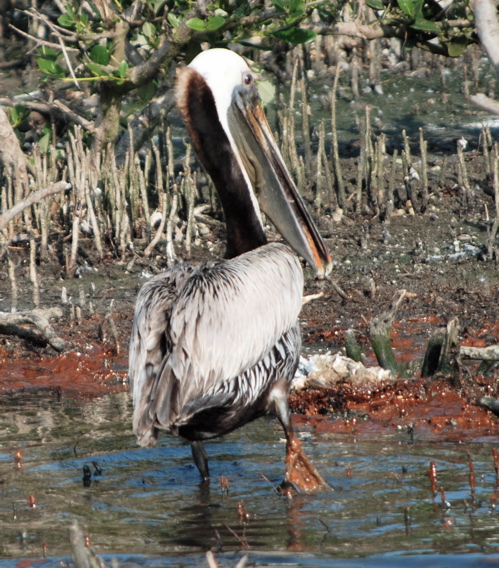
There are no pictures and no mention of the nasty, smelly tar patties on the beach and in the marshes and the long streaks and patches of reddish crap in the water. I doubt that Ivor would lie, but it seems to me that he puts a spin on the story by what he emphasizes and what he leaves out that is generally favorable to BP. The company Ivor works for, Polaris Applied Sciences, is under contract to BP to assist in clean-up operations, and they are not paid to give BP bad PR.

Read blogger New Orleans Ladder for another take on the story.
Whenever anyone says to me of the damage from the gusher, "It's not that bad," it's like waving a red flag in front of a bull. I've seen and heard too much to convince me now that "It's "not that bad".
UPDATE: And the video shows no pictures of oiled birds.