Friday, May 25, 2007

The Feast Day Of The Venerable Bede


"The Venerable Bede Translates John" by James Doyle Penrose (1862-1932)
Inset from "The last chapter (Bede)", exhibited at the Royal Academy (1902)


I was going to do a post on the saint of the day, but El Padre has beat me to it with a wonderful post, as is often the case. He's a crafty one, he is. Anyway, he saved me some work, and I'll just send you over there to see what he's done, giving you only this illustration, courtesy of Wiki.

Les Femmes Françaises


Le Pain Bénit by Pascal Adolphe Jean Dagnan Bouveret - 1885 - Musée d'Orsay, Paris


Yesterday, Grandpère and I had a lovely day in New Orleans. I left all thought of the squabbles in the Anglican Communion behind, (Grandpère has no thoughts on the squabbles) and we drove off to see Femmes, Femmes, Femmes, Paintings of Women in French Society From Daumier to Picasso, From the Museums in France. Since we, like apparently many others, had procrastinated in making the visit to the New Orleans Museum of Art, we found it fairly crowded, since the exhibit ends next week.

The exhibit was magnificent. The Renoir pictured in the post below is glorious. I have not often seen reproductions of The Excursionist, but it is a sight to behold. The reproduction does not do justice to the brilliance of the true colors. I purchased the catalog, but, as usual, some of the reproductions are not true to the colors of the paintings, and I will soon forget the true colors and come to think the colors in the catalog are the reality.

I chose the painting at the top, by Dagnan-Bouveret, because I loved the contrast between the somber colors of the clothing of the women and the bright white and red of the vestments of the altar boy. The faces of the girls and women are beautiful to see, with the realism of their expressions and the faithful representation of the results of time. The women are separated from the men in the traditional manner of the churches in the French Comté. Of Dagnon-Bouverey, the catalog says, "After an intense mytical experience, Dagnan-Bouveret painted little but religious subjects...."

Among the paintings were a good many representations of the lower classes of French society, both rural and urban, one a work titled "La Mort du Pauvre", by Jean-Pierre Alexandre Antigna, which affected me greatly. The woman sits at the side of her dead husband with her two children, a large tear rolling down her cheek. The little girl hugs her mother and the little boy stares straight at us with sad look. What will become of them now? I couldn't find a link to any but a very small reproduction, which is hardly worth viewing.

There was another called "The Striker's Wife," by Alfred Roll, in which the woman sits with her two children, looking to be in a state of shock. What will they eat while the strike goes on? Men are killed in strikes. What will happen to the mother and children? I came away from the portrayals of the poor with the thought that the lot of women has been hard through the ages. Again, I could find no illustration for a link.

Even among the middle and upper classes, the women were subject to the men until the 20th century and beyond. The show included a self- portrait of Berthe Morisot, which appears to be frank and clearly not especially self-flattering. The plaque beside the picture quotes these words of Morisot, "I do not believe there has ever been a man who treats a woman as his equal and it is all I will have asked for, because I am worth them all." She was a friend of Manet and Renoir and often posed for them.

Grandpère spent a good bit of time before the picture by Henri Gervex titled "Rolla", 1878". From the catalog, "The painting was inspired by a poem (Rolla) by Alfred de Musset....Marion is a young prostitute; the man (Jaques Rolla) is a despairing reveler, casting a final look at the young woman with whom he has spent the night. He is about to climb over the balcony and leap to his death." Once you read the story behind the painting, you look at it differently, more soberly.

After viewing the paintings, we went to a nearby restaurant call La Vita, a small Italian restaurant, and had an excellent lunch. Altogether, it was a day of la vie douce or la dolce vita; take your choice.

Thursday, May 24, 2007

Off To See The French Femmes


The Excursionist by Pierre Auguste Renoir


Today we're going to the New Orleans Museum of Art to see this: FEMMES - Paintings of Women in French Society from Daumier to Picasso from the Museums of France.

Afterwards we will find a good restaurant to have lunch. Many of the excellent restaurants have reopened since Katrina, so we should have no difficulty.

Our own country didn't care for the citizens of the city, but the French cared enough to send this wonderful exhibit to the folks of New Orleans and to help tourism spring back.

UPDATE: We're not off to see the Femmes. I checked the museum's web site, and they are CLOSED ON TUESDAYS! We'll try again on Thursday. Good thing I checked.

Anyway, it's a pretty picture.

UPDATE 2: Moved up again. Today we really are going to see the Femmes.

UPDATE 3: The Femmes were fabulous! The Renoir pictured above was absolutely gorgeous. I'll write more about our day trip later.

Tuesday, May 22, 2007

Lambeth 2008

Let's Call The Whole thing Off

Fred Astaire
(words by Ira Gershwin; music by George Gershwin)
Introduced by Fred Astaire and Ginger rogers in the film "Shall We Dance?"

(verse)
Things have come to a pretty pass,
Our romance is growing flat,
For you like this and the other
While I go for this and that.
Goodness knows what the end will be;
Oh, I don't know where I'm at...
It looks as if we two will never be one,
Something must be done.

(refrain)
You say eether and I say eyether,
You say neether and I say nyther;
Eether, eyether, neether, nyther,
Let's call the whole thing off!
You like potato and I like potahto,
You like tomato and I like tomahto;
Potato, potahto, tomato, tomahto!
Let's call the whole thing off!
But oh! If we call the whole thing off,
Then we must part.
And oh! If we ever part,
Then that might break my heart!
So, if you like pajamas and I like pajahmas,
I'll wear pajamas and give up pajahmas.
For we know we need each other,
So we better call the calling off off.
Let's call the whole thing off!

You say laughter and I say lawfter,
You say after and I say awfter;
Laughter, lawfter, after, awfter,
Let's call the whole thing off!
You like vanilla and I like vanella,
You, sa's'parilla and I sa's'parella;
Vanilla, vanella, Choc'late, strawb'ry!
Let's call the whole thing off!
But oh! If we call the whole thing off,
Then we must part.
And oh! If we ever part,
Then that might break my heart!
So, if you go for oysters and I go for ersters
I'll order oysters and cancel the ersters.
For we know we need each other,
So we better call the calling off off!
Let's call the whole thing off!

Bishop Robinson Is A Gentleman

According to The Living Church:

The Bishop of New Hampshire will not be invited to participate in the 2008 Lambeth Conference, according to the Rev. Canon Kenneth Kearon, secretary of the Lambeth Conference.

....

Bishop Robinson was traveling when the announcement was made, but issued a statement in response to the news.

“It is with great disappointment that I receive word from the Archbishop of Canterbury that I will not be included in the invitation list for the Lambeth Conference, 2008," he said. "At a time when the Anglican Communion is calling for a 'listening process' on the issue of homosexuality, it makes no sense to exclude gay and lesbian people from that conversation. It is time that the bishops of the Anglican Communion stop talking about gay and lesbian people and start talking with us.

“While I appreciate the acknowledgement that I am a duly elected and consecrated bishop of the Church, the refusal to include me among all the other duly elected and consecrated bishops of the Church is an affront to the entire Episcopal Church," he said. "This is not about Gene Robinson, nor the Diocese of New Hampshire. It is about the American Church and its relationship to the Communion. It is for The Episcopal Church to respond to this challenge, and in due time, I assume we will do so. In the meantime, I will pray for Archbishop Rowan and our beloved Anglican Communion."

Bishop Robinson was not expected to comment further until he has spoken with Presiding Bishop Katharine Jefferts Schori.


Everyone is writing about this, but I wanted to acknowledge Bishop Robinson's brief but gentlemanlike response.

Certain of the bishops, who have invested heavily in the Windsor process, seem to take the cafeteria approach of pick and choose what you like from the report and leave the rest. Much attention has been given to the importance of adhering to the moratorium against ordaining partnered gay and lesbian clergy and the blessing of same-sex unions.

However, the listening process called for in the Windsor Report has not received nearly as much attention. How widespread is the listening process among the dioceses of the Windsor Bishops? As far as I know, there's nothing much in the way of a listening process happening in my diocese.

Bishop Robinson makes the important point that it's past time for TEC and the members of the Anglican Communion to stop talking about gay and lesbian members of the body and begin to listen to them, to have conversations with them, to hear their stories. It seems to me that what we're talking about here is not so much changing minds but about changing hearts. Stories change hearts.

I have no advice to offer the Presiding Bishop nor the other US bishops as to what their response should be, but I will offer my prayers that they will be guided by Holy Spirit and that they receive godly wisdom, knowledge, and understanding as they make their way.

Monday, May 21, 2007

Sunset Through The Trees


Psalm 19

The heavens are telling the glory of God;
and the firmament proclaims his handiwork.
Day to day pours forth speech,
and night to night declares knowledge.
There is no speech, nor are there words;
their voice is not heard;
yet their voice goes out through all the earth,
and their words to the end of the world.


The sunset through the trees signals the end of the day. As the sun dips below the horizon, it bursts forth in one last blast of light showing forth the glory of God.


O God of the night, be with us. Grant us your protection during the dark hours. The night, no less than the day, is yours. Keep us safe from harm and bring us to a new dawn, a new light, in Jesus name. Amen.

Archbishop Ndungane's Speech

I am struggling to write a post on Archbishop Njongonkulu Ndungane's speech to the Bishop's Forum in Capetown, South Africa, on May 15, 2007, which is one of the best I have seen. It is both eloquent and clear. Upon reading the speech, one is not left wondering, "Now what did he mean by that statement?" Archbishop Ndungane speaks plainly.

In addition to being an excellent example of pastoral leadership, it provides a capsule history of Anglicanism.

I'm trying to work out how to highlight the best of the speech, but it's difficult because the whole of the speech is so good. I encourage you to read it in its entirety. I printed it from the link at the top of my post, because I don't like to read long pieces online.

What I'll do is give you quotes of some of his words, without much in the way of context, in hopes that this will entice you to read the whole speech.

Communion and the Anglican Communion

The word Anglicanism first emerged in the 1830s, and the phrase 'Anglican Communion' was first used in 1851, and by 1860 was recognised as referring to our fellowship of legally independent Churches, worshipping in the tradition of the Anglican Prayer Book, with a ministry of bishops, priests and deacons, and in communion with the See of Canterbury.

In this sense, the 'Anglican Communion' was never established, as was the case of, for example, the Lutheran World Federation. It just emerged, out of the various historic developments that acknowledge some historic link to the See of Canterbury. Provinces themselves also evolved in an ad hoc manner, with no consistency even between founding documents (for example, some refer to the 39 Articles, though we do not, references to the Church of England vary considerably).


The Birth of the Lambeth Conference:

So the meeting went ahead, not as a Synod, or a Council, but as a Conference. Bishops were not 'summoned to decide', but 'invited to confer'. It was also made entirely clear that none of the resolutions would have any binding force.

....

As you know, that process is still with us. It is a salutary lesson that division may provide an immediate solution to seemingly implacable differences, but in the long term is no solution whatsoever to our call to communion within the Body of Christ.

....

But we should take heart, because Communion is God's gift - and it is from our Communion with him that all else springs. Our Church has life, not because of who we are, but because of who God is, and his gift of His Spirit, which sustains us, and leads us into all truth.


The Instruments of Unity

These include the Archbishop of Canterbury, the Lambeth Conference, the Primates Meetings, and the Anglican Consultative Council. Of the ACC, he says:

One touchstone of Anglicanism has been the involvement of laity in the governing of the Church. We are not ruled from above by a Pope and a Curia of Bishops. Rather, we believe that God's Spirit is at work in all God's people to build up the whole Body of Christ. Paul tells the Corinthian church 'to each one the manifestation of the Spirit is given for the common good' (1 Cor12:7), For this reason, we describe ourselves as 'both episcopally led and synodically governed'. In our synods, all God's people are represented - Bishops, clergy and laity.

....

It alone of the Instruments of Unity has a formal constitution, which includes among its objectives 'to advise on inter-Anglican, provincial and diocesan relationships...'

So both by reason of its constitution, and by reason of the theological and ecclesial understandings of what it means to be church which underpin the constitution, my conviction is that this is the Instrument of Unity which should primarily be the place for handling the current difficulties and the inter-Anglican, provincial and relationships that are affected by them.


The Primates Meeting

Yet it seems that centre stage s increasingly being given to the Primates - and I very much regret this.

The Windsor Process

Whatever the merits of the various positions on human sexuality, my greatest sadness is that we have allowed ourselves, within the Primates' meeting in particular, to lose sight of what it means to live in Communion.

The Draft Covenant

I will be honest and say that beyond my continuing question of whether a Covenant is really the best way ahead, my serious concern with the current draft is that the ACC is being sidelined, and far too much power is being given to the Primates' Meeting.

I fear we are in danger of setting up something akin to the Roman Curia - and I am especially worried that the Primates, gifted and blessed and called as they are in so many ways, are nonetheless so unrepresentative of the totality of the Body of Christ. Even the representative breadth of the Lambeth Conference is questionable.

My theology continues to tell me that it is in and through our widest councils that we will most fully discern both what we should do, and how we should go about it.

Conclusion

So whether it was the preaching of the gospel to the Gentiles, or the precise understanding of the Eucharist, or the various models of salvation, or slavery, or usury, or contraception, or women's ordination - or even questions over vestments, and whether, and how high, to raise up the bread and wine with the words of consecration - well, God is bigger! And the unity that he grants us is a gift of grace that can overcome all manner of human disagreement.

In March, we hosted the International Anglican Communion's TEAM conference - Towards Effective Anglican Mission. I continue to hear stories about how the experience of participants was that our common life of mission and ministry in Christ bridges our disagreements. It was also evident that human sexuality is not the prime concern for most Christians in their life of faith.

....

I suspect that future generations will see this as something of a storm in a teacup, and certainly not as central to the Christian life.

For the centre of Christian life is Jesus Christ. As I said at the TEAM conference, God's eternal Word did not come as a philosophical concept, nor as a political programme. Nor was the Word made text. But the Word became flesh, and dwelt among us, full of grace and truth.

It is not where we stand on this or that particular issue which is definitive for our salvation - nor even our understanding of this or that passage of Scripture. What matters is our relationship with Jesus Christ, who gave his life for us on the cross, and who was raised to new life, so that we too might find new life in him.

Alleluia! Christ is Risen!

Sunday, May 20, 2007

New Bishop In Pennsylvania

From The Living Church Foundation:

Clergy and lay delegates to a special convention in the Diocese of Northwestern Pennsylvania elected a local priest with three generations of family roots in the diocese as their next bishop. The Rev. Sean W. Rowe, rector of St. John’s Church, Franklin, Pa., was elected on the first ballot from a field of four nominees, May 19 at the Cathedral of Church of St. Paul in Erie.

....

In an autobiographical profile published on the internet by the diocesan search committee, Fr. Rowe states that as a student attending Grove City College he “experienced the Kingdom of God break into my spiritual life” with the help of a campus ministry chaplain from The Episcopal Church. He and his wife, Carly, are co-chairs of the diocesan youth and young adult commission. A graduate of Virginia Theological Seminary, he has served as rector of St. John’s since his ordination in 2000 by the Rt. Rev. Robert D. Rowley.

....

Fr. Rowe must now receive consent from a majority of the 110 standing committees and bishops with jurisdiction in The Episcopal Church. The consecration is tentatively scheduled for Sept. 8 at Grove City College. When he takes office, Fr. Rowe, who turned 32 on Feb. 16, will be the youngest member of the House of Bishops, according to information supplied to the diocese by the office of the canon to the Presiding Bishop.


A bishop at the age of 32!

Father we ask your blessing upon Sean and that you fill him with the power of the Holy Spirit. Fill his heart with your love, and give him gifts of wisdom, knowledge, and understanding to lead the priests and people of the diocese. We ask in the name of Our Lord Jesus Christ. Amen.

Saturday, May 19, 2007

The Bells Of Wenchoster

In keeping with yesterday's tribute to St. Dunstan, who was a metal worker and bell caster, I decided to check in at the site of the Diocese of Wenchoster once more to seek information on their bells. Here begins the history of their bells:

The Cathedral Bells

There were three bells in the cathedral church of St. Ennodius and St. Veronica during the reign of Henry the Eighth but their weight and inscriptions are unknown. An ancient manuscript in the Chained Library records how Bishop Tosspot (Toby Codpiecium 1519-1530) ordered their removal since the ringing kept him awake on Sunday mornings. It is known that the bells were indeed taken down, but what happened to them is lost in the mists of the Wen valley. A new set of three were commissioned by Tosspot's successor, Bishop Overweight (Alfred Codpiecium 1530-1539). In 1605, Bishop Wearside, on being cleared of implication in the Gunpowder Plot, commissioned a new bell to mark the saving of Parliament. Bishop Thrust paid for a pair of bells in 1688, and the un-tuned ring of the bells was converted into a peal of six at a cost of 5,000 groats.


To get the full story, of course, you must go to their web site, but I will add that the firm of "David Vascular & Sons of Watercloset Lane, Smithfield" added three more bells for a total of nine. The names and details of the inscriptions on all nine bells are to be found at the diocesan site.

Wenchoster Cathedral is proud to possess the monument to Robert (Plain Bob) Oakhandle, the only one-legged, blind ringer to ever to have participated in a full peal (pictured above with the Dean and Ringing team of 1899). This feat was achieved in 1898 and has yet to be equalled. The annual Ringers Guild service is held next to his memorial on anniversary of his death, (May 29th).

You can find the picture of the group on the site, along with a picture of the bell-ringing team which celebrated the coronation of Queen Elizabeth II.

The bell ringing team of 1952 after their marathon 24-hour peal to celebrate the coronation. The hooded-figure at the back right of the picture is Brother D'Eath OHHSV of whom little is known. None of the members of this team could ever remember him being invited to attend.

Actually, Elizabeth II's accession to the throne was in 1952, but the coronation ceremony did not take place until 1953. Surely a simple slip of the typing finger by one of the editors.

The web site of the Diocese of Wenchoster is rich and full of history and present day news, enough to offer material for several more posts for my blog, plus, the editors of the site add to their material and are kind enough to send me an email each time something new goes up.

I had thought of doing a post on their organs, but I found the organ site loaded with specifications and details which were absolute Greek to me, so I thought I'd best leave that to someone more knowledgeable. Sorry, David Charles Walker. The names for the organ pipes are intriguing, and I like that their tuba pipe is named Tubby. Their organ charts indicate that wind passes in, and wind passes out, but I know nothing about that.

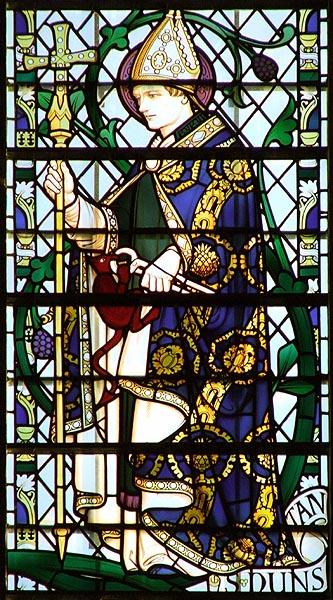
Feast Of St. Dunstan Of Canterbury


Image from Early British Kingdoms


Dunstan was born near Glastonbury in the southwest of England about the year 909, ten years after the death of King Alfred. During the Viking invasions of the ninth century, monasteries had been favorite targets of the invaders, and by Dunstan's time English monasticism had been wiped out. In its restoration in the tenth century, Dunstan played the leading role.

....

(Glastonbury is one of the oldest Christian sites in England, and is associated in legend with King Arthur and his Court, with Joseph of Arimathea, and with other worthies. It has been said that the Holy Grail, the chalice of the Last Supper, is hidden somewhere near Glastonbury.) Under Dunstan's direction, Glastonbury became an important center both of monasticism and of learning. The next king, Edred, adopted Dunstan's ideas for various reforms of the clergy (including the control of many cathedrals by monastic chapters) and for relations with the Danish settlers. These policies made Dunstan popular in the North of England, but unpopular in the South.

Edred was succeeded by his sixteen-year-old nephew Edwy, whom Dunstan openly rebuked for unchastity. The furious Edwy drove Dunstan into exile, but the North rose in rebellion on his behalf. When the dust settled, Edwy was dead, his brother Edgar was king, and Dunstan was Archbishop of Canterbury. The coronation service which Dunstan compiled for Edgar is the earliest English coronation service of which the full text survives, and is the basis for all such services since, down to the present. With the active support of King Edgar, Dunstan re-established monastic communities at Malmesbury, Westminster, Bath, Exeter, and many other places. Around 970 he presided at a conference of bishops, abbots, and abbesses, which drew up a national code of monastic observance, the "Regularis Concordia". It followed Benedictine lines, but under it the monasteries were actively involved in the life of the surrounding community. For centuries thereafter the Archbishop of Canterbury was always a monk.


In addition, Dunstan was a musician, a bell maker, and a painter.

From the The Lectionary


PRAYER

Almighty God, who raised up Dunstan to be a true shepherd of the flock, a restorer of monastic life and a faithful counsellor to those in authority: give to all pastors the same gifts of your Holy Spirit that they may be true servants of Christ and all his people; through Jesus Christ our Lord, who lives and reigns with you and the Holy Spirit, one God, now and for ever.