Several members of my family are seriously disturbed by the economic downturn, close to freaking out, I'd say. We watch our nest eggs shrink day by day. One or two family members are quite concerned that they will lose their jobs. I'm concerned, too, but there's not much I can do to turn the economy around. We're headed for difficult times, but I know that many will be, and indeed already are, much worse off than we are.
My thought, which I expressed to Grandpère, is that we have no choice but to go through the bad times. Our only choice is to decide how we will live through the economic woes. We can try to do it with a measure of grace and dignity and with care and concern for those who are worse off than we are, or we can bitch and moan and cry out, "Woe is me!" over and over. Go through the tough times we will anyway, so let's do it with a bit of class. GP is not impressed by my thought.
Saturday, March 7, 2009


Blog Posts You Should Read
For a while now I've been reading Bishop Alan's Blog. He is the Area Bishop of Buckinghamshire in England. I especially liked his post titled Reading the Bible 101. According to Bishop Alan, those who interpret the Bible in a literalist manner are latecomers in the history of Christianity.
The idea that the “factual/ original” meaning of a text is its only real one dates back to Benjamin Jowett in 1859, the year the Origin of Soecies was published. People who lived before then were not fools. Wooden fundamentalism about the Bible was not the only option before Darwin.
Read the comments to the post, because the discussion there is enlightening, too, especially Bishop Alan's long reply to one of the comments.
For the two or three of you who visit here and do not read Of Course I Could Be Wrong, I urge you to read MadPriest's sermon for the 2nd Sunday of Lent. The Lenten theme at his parish church this year is "The Marginalized".
MadPriest speaks of his own madness in connection with Jesus' words from the Gospel in which he says:
“If any want to become my followers, let them deny themselves and take up their cross and follow me. For those who want to save their life will lose it, and those who lose their life for my sake, and for the sake of the gospel, will save it.
Read the sermon. Read MadPriest's story. You won't be sorry. He says:
So, that is my burden. But I had other crosses to bare before it and it is almost certain I will have others in the future. And all of you will be carrying crosses, as well. Illness, abuse, sorrow, family duties, fear. The list seems endless. And I suppose we now have to ask the million dollar question. Does God impose these, sometimes unbearable, burdens upon us?
My answer to that question is a definite “no.” For God to do so he would have to contradict everything that Jesus told us about God and his relationship with us and his feelings, towards us. Our burdens are just part of life.
And last, but most certainly, not least, read Themethatisme's moving memories of the closing of the coal mines by Margaret Thatcher. This week is the 25th anniversary of those events. I remember the shock I felt over here, across the sea, when the announcement was made.
It may be just my perspective from the inside but when people asked me what is wrong with society today I am always tempted to talk about the strike. This was the first time on a national scale that the public saw a community destroyed. The uncertainty and lack of future that was intimated in such a destruction told forth that Mrs.Thatchers claim that there was no such thing as community, was a reality. Self-seeking individuality was the name of the game and anyone who acted collectively would be effectively frozen out or beaten into submission.
And isn't that the truth?
Go on now. Move along.
The idea that the “factual/ original” meaning of a text is its only real one dates back to Benjamin Jowett in 1859, the year the Origin of Soecies was published. People who lived before then were not fools. Wooden fundamentalism about the Bible was not the only option before Darwin.
Read the comments to the post, because the discussion there is enlightening, too, especially Bishop Alan's long reply to one of the comments.
For the two or three of you who visit here and do not read Of Course I Could Be Wrong, I urge you to read MadPriest's sermon for the 2nd Sunday of Lent. The Lenten theme at his parish church this year is "The Marginalized".
MadPriest speaks of his own madness in connection with Jesus' words from the Gospel in which he says:
“If any want to become my followers, let them deny themselves and take up their cross and follow me. For those who want to save their life will lose it, and those who lose their life for my sake, and for the sake of the gospel, will save it.
Read the sermon. Read MadPriest's story. You won't be sorry. He says:
So, that is my burden. But I had other crosses to bare before it and it is almost certain I will have others in the future. And all of you will be carrying crosses, as well. Illness, abuse, sorrow, family duties, fear. The list seems endless. And I suppose we now have to ask the million dollar question. Does God impose these, sometimes unbearable, burdens upon us?
My answer to that question is a definite “no.” For God to do so he would have to contradict everything that Jesus told us about God and his relationship with us and his feelings, towards us. Our burdens are just part of life.
And last, but most certainly, not least, read Themethatisme's moving memories of the closing of the coal mines by Margaret Thatcher. This week is the 25th anniversary of those events. I remember the shock I felt over here, across the sea, when the announcement was made.
It may be just my perspective from the inside but when people asked me what is wrong with society today I am always tempted to talk about the strike. This was the first time on a national scale that the public saw a community destroyed. The uncertainty and lack of future that was intimated in such a destruction told forth that Mrs.Thatchers claim that there was no such thing as community, was a reality. Self-seeking individuality was the name of the game and anyone who acted collectively would be effectively frozen out or beaten into submission.
And isn't that the truth?
Go on now. Move along.
Friday, March 6, 2009
Who Amongst Us Is Without Sin?
In Chapter 10 of Mark's Gospel, Jesus speaks to the Pharisees and to his disciples about divorce, about allowing the children to come to him for blessings, and instructs those around him to come approach the Kingdom of God like a child.
Then came a man to Jesus asking the way to eternal life. Jesus lists the commandments. The man replies that he has kept the commandments from a young age. Then from the Gospel:
Jesus, looking at him, loved him and said, ‘You lack one thing; go, sell what you own, and give the money* to the poor, and you will have treasure in heaven; then come, follow me.’ When he heard this, he was shocked and went away grieving, for he had many possessions.
Every time I read that passage, I stand convicted. There are those who say that Jesus didn't really mean those words, that he meant that we should not be greedy and have possessions in excess. Society couldn't function if everyone literally followed those directives.
Of course, Jesus' words are impractical. Pragmatism was not Jesus' strong suit. Who amongst us is innocent, except the destitute and those who have given up their possessions to live and work amongst the poor? I believe that Jesus meant the words. Do I follow them? No, I do not. I could not have cast the first stone at the woman caught in adultery. Trust me; I am going somewhere with this besides lay sermonizing.
Those former and present members of the Episcopal Church who long for and attempt to build a pure church try in vain, "since all have sinned and fall short of the glory of God;" (Rom. 3:23) To attempt to build a pure church consisting of humans who have sinned and fallen short is simply not possible. The church is the Body of Christ and is sanctified by Christ himself, not by the beliefs or mistaken beliefs, or good or sinful acts or omissions of the imperfect members of the Body. The church is not my church, or your church, or their church, but God's church. We, the members of the church, put our faith and trust in a loving and merciful God to take us where we should go, not in purity of doctrines or "thou shalt nots" declared by imperfect human beings.
The reason that I am against a Covenant for the Anglican Communion is because we have the Covenant of God with his people in the Hebrew Testament, and we have Jesus building on that Covenant with the New Covenant of "love God, love your neighbor". What is lacking in the New Covenant? Why would we expect imperfect humans to come up with a superior, or even an equal covenant? We have the Baptismal Covenant and the Prayer Book which bind us together as Anglicans. What further need for a Covenant?
The man in the Gospel story went away grieving because of his many possessions, but, just as Jesus loved him when he spoke the words to him, he loved the man still when he walked away. And he loves us, just as we are, sinners all. In that love of God, I put my faith and hope.
My two cents, inspired by this post by Rmj at Adventus. Any mistakes here are my own and not attributable to Rmj.
UPDATE: I was late to the Lectionary today, and I found the readings pertinant to the words that I posted:
AM Psalm 95 & 40, 54
PM Psalm 51
Deut. 10:12-22
Heb. 4:11-16
John 3:22-36
Then came a man to Jesus asking the way to eternal life. Jesus lists the commandments. The man replies that he has kept the commandments from a young age. Then from the Gospel:
Jesus, looking at him, loved him and said, ‘You lack one thing; go, sell what you own, and give the money* to the poor, and you will have treasure in heaven; then come, follow me.’ When he heard this, he was shocked and went away grieving, for he had many possessions.
Every time I read that passage, I stand convicted. There are those who say that Jesus didn't really mean those words, that he meant that we should not be greedy and have possessions in excess. Society couldn't function if everyone literally followed those directives.
Of course, Jesus' words are impractical. Pragmatism was not Jesus' strong suit. Who amongst us is innocent, except the destitute and those who have given up their possessions to live and work amongst the poor? I believe that Jesus meant the words. Do I follow them? No, I do not. I could not have cast the first stone at the woman caught in adultery. Trust me; I am going somewhere with this besides lay sermonizing.
Those former and present members of the Episcopal Church who long for and attempt to build a pure church try in vain, "since all have sinned and fall short of the glory of God;" (Rom. 3:23) To attempt to build a pure church consisting of humans who have sinned and fallen short is simply not possible. The church is the Body of Christ and is sanctified by Christ himself, not by the beliefs or mistaken beliefs, or good or sinful acts or omissions of the imperfect members of the Body. The church is not my church, or your church, or their church, but God's church. We, the members of the church, put our faith and trust in a loving and merciful God to take us where we should go, not in purity of doctrines or "thou shalt nots" declared by imperfect human beings.
The reason that I am against a Covenant for the Anglican Communion is because we have the Covenant of God with his people in the Hebrew Testament, and we have Jesus building on that Covenant with the New Covenant of "love God, love your neighbor". What is lacking in the New Covenant? Why would we expect imperfect humans to come up with a superior, or even an equal covenant? We have the Baptismal Covenant and the Prayer Book which bind us together as Anglicans. What further need for a Covenant?
The man in the Gospel story went away grieving because of his many possessions, but, just as Jesus loved him when he spoke the words to him, he loved the man still when he walked away. And he loves us, just as we are, sinners all. In that love of God, I put my faith and hope.
My two cents, inspired by this post by Rmj at Adventus. Any mistakes here are my own and not attributable to Rmj.
UPDATE: I was late to the Lectionary today, and I found the readings pertinant to the words that I posted:
AM Psalm 95 & 40, 54
PM Psalm 51
Deut. 10:12-22
Heb. 4:11-16
John 3:22-36
What's He Gonna Be?
An old country preacher had a teenage son, and it was getting time the boy should give some thought to choosing a profession. But like many young men, the boy didn't really know what he wanted to do, and he didn't seem too concerned about it, either.
One day, while the boy was away at school, his father decided to try an experiment. He went into the boy's room and placed on his study table four objects: a Bible, a silver dollar, a bottle of whiskey, and a Playboy magazine.
"I'll just hide behind the door," the old preacher said to himself, "and when he comes home from school this afternoon, I'll see which object he picks up. If it's the Bible, he's going to be a preacher just like me and what a blessing that would be! If he picks up the dollar, he's going to be a businessman, and that would be okay, too. But if he picks up the bottle, he's going to be a no-good drunkard, and, Lord, what a shame that would be. And worst of all, if he picks up that magazine he's gonna be a skirt-chasin' bum."
The old man waited anxiously, and soon heard his son's footsteps as he entered the house whistling and headed for his room.
The boy tossed his books on the bed, and as he turned to leave the room he noticed the objects on the table. With curiosity in his eye, he walked over to inspect them. Finally, he picked up the Bible and placed it under his arm. Furtively looking around, he picked up the silver dollar and dropped it into his pocket. Then he uncorked the bottle and took a big drink as he sat down on his bed and opened up the magazine to the centerfold.
"Lord have mercy," the old preacher disgustedly whispered to himself, "he's gonna run for Congress!"
Don't blame me, blame Doug.
One day, while the boy was away at school, his father decided to try an experiment. He went into the boy's room and placed on his study table four objects: a Bible, a silver dollar, a bottle of whiskey, and a Playboy magazine.
"I'll just hide behind the door," the old preacher said to himself, "and when he comes home from school this afternoon, I'll see which object he picks up. If it's the Bible, he's going to be a preacher just like me and what a blessing that would be! If he picks up the dollar, he's going to be a businessman, and that would be okay, too. But if he picks up the bottle, he's going to be a no-good drunkard, and, Lord, what a shame that would be. And worst of all, if he picks up that magazine he's gonna be a skirt-chasin' bum."
The old man waited anxiously, and soon heard his son's footsteps as he entered the house whistling and headed for his room.
The boy tossed his books on the bed, and as he turned to leave the room he noticed the objects on the table. With curiosity in his eye, he walked over to inspect them. Finally, he picked up the Bible and placed it under his arm. Furtively looking around, he picked up the silver dollar and dropped it into his pocket. Then he uncorked the bottle and took a big drink as he sat down on his bed and opened up the magazine to the centerfold.
"Lord have mercy," the old preacher disgustedly whispered to himself, "he's gonna run for Congress!"
Don't blame me, blame Doug.
Thursday, March 5, 2009
Final, Final Word On ABS' Episcopal Church Listing
See Tobias Haller's post on the final resolution of the missing listings for the Episcopal Church on the American Bible Society's website.
Finally, We Meet!

Yesterday, a friend and I planned to have lunch together. We met at church some years ago, and we get along well, like the same books, and mean to get together more often than we do, but we manage only about one meeting a year, with the exception of our meetings at church.
We decided that we'd try the new Mexican restaurant, El Paso, rather than the old Mexican restaurant, La Casa. My friend and I are about the same age, and we're both somewhat "head-in-the clouds" types, not much given to nailing down the details. I had only a vague idea of where El Paso was, didn't know the name at the time to give to my friend, and when I tried to find it, I could not. I rode around in the vicinity for about 10 or 15 minutes with no success. I passed La Casa and thought about stopping there to see if my friend was there, but I decided against it and returned home.
Why didn't we exchange cell phone numbers? Why didn't I tell her to meet me at my house, which is near the restaurant? Grandpère shook his head, when I came back home. I called my friend's house, but, of course, no answer. GP told me again where El Paso was, and I took off and found it with a sign saying "El Paso coming soon!", but the building was still being renovated, and the restaurant was surely not open. I went back home and thought about what to do. Now I am quite late for lunch. I didn't even look at the clock to see how late, because I didn't want to know. La Casa had moved to a new location several months ago, and as a last resort to try to save our date, I called La Casa to see if my friend was there, and indeed she was! I told the staff person to tell her that I was on my way and would be there in a few minutes.
My friend had ordered and was eating her lunch, which consoled me a little. I apologized profusely, and she said that it was really her fault, because she did not know that the new La Casa was the old restaurant in a new location. I ordered a glass of wine (to be brought quickly) and my lunch and we did the Alphonse and Gaston (link for the youngsters) routine for a while and then settled in to enjoy lunch and conversation, which we very much did, and then pledged to get together before a year passed for another misadventure. It was really all my fault, and I'm a bit surprised that my friend wants to try again, but she is a lovely and forgiving person.
Image from Wiki.
I've Done It More Than Once
Click on the picture to enlarge.

We're a small church, but, when folks who regularly attend one Sunday service, show up at the other service, I've done that very thing. Now when I meet someone whom I think may be a newcomer, I've learned to put my hand out and say, "Hi, I'm June," and stop there.
With thanks to ASBO Jesus.
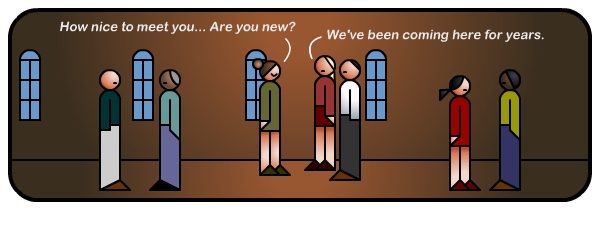
We're a small church, but, when folks who regularly attend one Sunday service, show up at the other service, I've done that very thing. Now when I meet someone whom I think may be a newcomer, I've learned to put my hand out and say, "Hi, I'm June," and stop there.
With thanks to ASBO Jesus.
Wednesday, March 4, 2009
Oyster Is Wicked, Wicked, Wicked
The immature man (by his own admission) who writes at Your Right Hand Thief has outdone himself. Not only has he thought bad thoughts about an innocent post of mine (and during Lent, too!), and committed a string of other sins in a single post, he tells a story about defective flushable wipes.
That reminds me: I recently purchased a box of defective flushable wipes. In what way were they defective? Well... how can I put this? The concentration of "cleansers and emollients" on the wipes exceeded any conceivable household or industrial standard.
That's all I'll quote from the story. You are forewarned. If you're squeamish about stories of (perfectly natural) bodily functions and minor, though painful, maladies, then you may not want to follow the link and read the rest. On the other hand, if you enjoy the occasional laugh at the misfortune of another, then....
Oyster is a New Orleanian by adoption only. Natives of the city are not nearly so wicked.
That reminds me: I recently purchased a box of defective flushable wipes. In what way were they defective? Well... how can I put this? The concentration of "cleansers and emollients" on the wipes exceeded any conceivable household or industrial standard.
That's all I'll quote from the story. You are forewarned. If you're squeamish about stories of (perfectly natural) bodily functions and minor, though painful, maladies, then you may not want to follow the link and read the rest. On the other hand, if you enjoy the occasional laugh at the misfortune of another, then....
Oyster is a New Orleanian by adoption only. Natives of the city are not nearly so wicked.
Jindal Won't/Will Take The Federal Money
From the News Star in Monroe, Louisiana:
Louisiana Gov. Bobby Jindal brought most of his Cabinet here Monday afternoon to offer moral and tangible support to a group of 500 desperate Pilgrim's Pride contract growers and employees whose livelihoods are at risk following the company's decision to idle its northeastern Louisiana and southern Arkansas operations.
Advertisement
Pilgrim's Pride announced its decision on Friday, saying it will eliminate 1,300 jobs in Union and the surrounding parishes and 800 jobs in El Dorado, Ark., within 75 days. Almost 300 independent growers will also likely be ruined by the closures.
....
Jindal said that the state would apply for Trade Adjustment Assistance from the federal government, which would expand unemployment benefits to employees and provide benefits to growers who aren't eligible for unemployment benefits. The state was recently granted Trade Adjustment Assistance for International Paper workers who lost their jobs when IP closed its Bastrop paper mill late last year.
From Politico just a couple of weeks ago:
Louisiana Gov. Bobby Jindal announced Friday that he will decline stimulus money specifically targeted at expanding state unemployment insurance coverage, becoming the first state executive to officially refuse any part of the federal government’s payout to states.
Different federal money? Not stimulus money? Still federal money. Still running up the deficit. What's the deal, Guv?
And the latest in the saga of Governor Jindal's wide-ranging travels from the Times-Picayune:
Gov. Bobby Jindal's string of out-of-state fundraising visits continues this week with a California trip that will include four stops to raise money for his 2011 re-election campaign.
Jindal traveled to Malibu, Calif., for a Tuesday evening fundraiser in a private residence, according to the governor's press office. Today, the governor is scheduled to raise money in San Diego, Fairfield and Palo Alto before heading back to Baton Rouge.
Since the start of the year the governor has visited Mississippi, Arkansas, North Carolina and Florida to meet donors and raise campaign cash. Jindal raised $3.5 million in 2008 for his 2011 campaign despite having no challengers in sight.
Some might say that Governor Jindal should spend a tad, just a tad, more time minding the store in the state which elected him governor.
Louisiana Gov. Bobby Jindal brought most of his Cabinet here Monday afternoon to offer moral and tangible support to a group of 500 desperate Pilgrim's Pride contract growers and employees whose livelihoods are at risk following the company's decision to idle its northeastern Louisiana and southern Arkansas operations.
Advertisement
Pilgrim's Pride announced its decision on Friday, saying it will eliminate 1,300 jobs in Union and the surrounding parishes and 800 jobs in El Dorado, Ark., within 75 days. Almost 300 independent growers will also likely be ruined by the closures.
....
Jindal said that the state would apply for Trade Adjustment Assistance from the federal government, which would expand unemployment benefits to employees and provide benefits to growers who aren't eligible for unemployment benefits. The state was recently granted Trade Adjustment Assistance for International Paper workers who lost their jobs when IP closed its Bastrop paper mill late last year.
From Politico just a couple of weeks ago:
Louisiana Gov. Bobby Jindal announced Friday that he will decline stimulus money specifically targeted at expanding state unemployment insurance coverage, becoming the first state executive to officially refuse any part of the federal government’s payout to states.
Different federal money? Not stimulus money? Still federal money. Still running up the deficit. What's the deal, Guv?
And the latest in the saga of Governor Jindal's wide-ranging travels from the Times-Picayune:
Gov. Bobby Jindal's string of out-of-state fundraising visits continues this week with a California trip that will include four stops to raise money for his 2011 re-election campaign.
Jindal traveled to Malibu, Calif., for a Tuesday evening fundraiser in a private residence, according to the governor's press office. Today, the governor is scheduled to raise money in San Diego, Fairfield and Palo Alto before heading back to Baton Rouge.
Since the start of the year the governor has visited Mississippi, Arkansas, North Carolina and Florida to meet donors and raise campaign cash. Jindal raised $3.5 million in 2008 for his 2011 campaign despite having no challengers in sight.
Some might say that Governor Jindal should spend a tad, just a tad, more time minding the store in the state which elected him governor.
The Latest And Final(?) Word On The ABS Listings
Regarding the missing listings for the Episcopal Church at the American Bible Society's website, here's Tobias in the comments:
Blogger Tobias Stanislas Haller said...
As it now stands, TEC shows up on the Find a Church directory as a Specific Denomination under "Anglican" chosen as the General Denomination. This was my initial concern, and it has now been fixed. At some point the Episcopal Church, which had been in the list of denominations, was removed. It's now back, and categorized properly as Anglican.
However, on the screen where a parish enters its own information for the directory display, the two drop-down data entry boxes refer to "primary denomination" and "secondary denomination." There is no listing for just plain "Anglican" on either of these ( they appear to be identical). So an Episcopal parish should you just choose "Episcopal Church" as the primary denomination. There is no way, using these fields, to indicate any connection with the Anglican Communion. (My suggestion to the ABS would be to add "Anglican Communion" to the denominational list.)
If an Episcopal parish wants to indicate that it is Anglican on its directory display, the answer is to add the word Anglican to the parish description. Making reference to the Anglican Communion in descriptions of Episcopal parishes was commended by general convention, if I'm not mistaken in 2006. I have done this for my parish using the tagline "The Anglican presence in Fordham since 1853."
That seems to be the state of things; my primary concern has been addressed; and as to who it was removed the Episcopal Church from the listings in the first place (if this was an intentional act)... well, truly they have their reward. (my emphasis)
Other WB posts on the missing listings are here and here.
Blogger Tobias Stanislas Haller said...
As it now stands, TEC shows up on the Find a Church directory as a Specific Denomination under "Anglican" chosen as the General Denomination. This was my initial concern, and it has now been fixed. At some point the Episcopal Church, which had been in the list of denominations, was removed. It's now back, and categorized properly as Anglican.
However, on the screen where a parish enters its own information for the directory display, the two drop-down data entry boxes refer to "primary denomination" and "secondary denomination." There is no listing for just plain "Anglican" on either of these ( they appear to be identical). So an Episcopal parish should you just choose "Episcopal Church" as the primary denomination. There is no way, using these fields, to indicate any connection with the Anglican Communion. (My suggestion to the ABS would be to add "Anglican Communion" to the denominational list.)
If an Episcopal parish wants to indicate that it is Anglican on its directory display, the answer is to add the word Anglican to the parish description. Making reference to the Anglican Communion in descriptions of Episcopal parishes was commended by general convention, if I'm not mistaken in 2006. I have done this for my parish using the tagline "The Anglican presence in Fordham since 1853."
That seems to be the state of things; my primary concern has been addressed; and as to who it was removed the Episcopal Church from the listings in the first place (if this was an intentional act)... well, truly they have their reward. (my emphasis)
Other WB posts on the missing listings are here and here.
Into The Spam Box Labeled "Troll"
And I didn't lift a finger. Thank you, GMAIL!
FREE Newt Newsletter
Get Newt Gingrich's weekly newsletter
delivered FREE to your email inbox
From the leader of the Republican revolution that swept Congress in 1994 comes a FREE newsletter defending the values that make our country great: Winning the Future with Newt Gingrich.
The Newt is positioning himself to save the Republican Party once again. Good luck with that, Newt!
PS: Did y'all get that the newsletter was FREE?
FREE Newt Newsletter
Get Newt Gingrich's weekly newsletter
delivered FREE to your email inbox
From the leader of the Republican revolution that swept Congress in 1994 comes a FREE newsletter defending the values that make our country great: Winning the Future with Newt Gingrich.
The Newt is positioning himself to save the Republican Party once again. Good luck with that, Newt!
PS: Did y'all get that the newsletter was FREE?
A Word From Roseann
Well, things are up and down as usual. UAMS called me at 8:30 last night and said they would not put me on the transplant list. Apparently I have too many other health issues to resolve before they will put me on the list. So, I will just keep moving forward step by step. First up is the cervical biopsy and I'm having that Tuesday. Next will be the breast biopsy and I'm really not worried about that.
Emotionally I am okay at the moment. I was a wreck after getting the phone call but Gary talked to Dr Kimball and we're just going to keep moving.
THE GOOD NEWS is my donor is compatible so far. He is still willing and will wait this out with me.
Please continue to pray for Roseann and her husband, Gary. She added:
Mimi, thanks for the encouraging note. I appreciate your posts for and about me. It helps me feel the prayers. Love & peace, Roseann
Emotionally I am okay at the moment. I was a wreck after getting the phone call but Gary talked to Dr Kimball and we're just going to keep moving.
THE GOOD NEWS is my donor is compatible so far. He is still willing and will wait this out with me.
Please continue to pray for Roseann and her husband, Gary. She added:
Mimi, thanks for the encouraging note. I appreciate your posts for and about me. It helps me feel the prayers. Love & peace, Roseann
Tuesday, March 3, 2009
Please Pray...
for Paul, the BB
I already told you about my suspected bronchitis. For that I made an appointment tomorrow. But something else was going on with my body yesterday afternoon and I saw the doc today. My laryngitis is chump change (though I do sound awful).
I have phlebitis.
I got shot in the hip to knock out nasty infections and tomorrow I will have a Doppler done to see if there is a clot or not. Then blood tests and any future action.
With age I have a number of greater and lesser health concerns and there will be upcoming things (not huge, just needful) to pursue. As a simple example, I have a knee that ain't what it used to be. Who doesn't sooner or later?
I know I don't even have to ask this crowd for prayers but thought you'd like to know.
UPDATE: From Paul - An update for y'all: NO BLOOD CLOT. The ultrasound showed my veins doing just fine. This is wonderful news and a huge relief. I do have an ugly infection but it is already being battled into submission. I am very grateful for the love and prayers that have come my way. See Paul, the BB's post.
and for Fran's friend, the lurker.
Enough about me, I'm fine and not so freaking important that my busy-ness matters one iota.
There is something way more important and I should not even be making small talk I am asking for prayers please. I have a friend who is a big lurker on these pages. She has come to know and read many of you, especially those in the cyber church
crowd, although I know she is also quite fond of at least one non-churchy type. I've barely linked to all the blog she reads - she is a much better blog friend than I am, so keep that in mind.
You just don't know her yet, but you will love her.
In any case, my friend and our lurker has some medical stuff going on and has a doctor's appointment on Friday. This appointment is very anxiety provoking for her... If you could send some prayers her way, that would be most welcome and most appreciated.
Thanks kids.
Mwah-mwah-mwah, kisses all around.
Yes, of course we will pray for you, dear Paul, for healing, and for you, dear lurker, for a good report from your medical test.
Blessings and love to you both.
I already told you about my suspected bronchitis. For that I made an appointment tomorrow. But something else was going on with my body yesterday afternoon and I saw the doc today. My laryngitis is chump change (though I do sound awful).
I have phlebitis.
I got shot in the hip to knock out nasty infections and tomorrow I will have a Doppler done to see if there is a clot or not. Then blood tests and any future action.
With age I have a number of greater and lesser health concerns and there will be upcoming things (not huge, just needful) to pursue. As a simple example, I have a knee that ain't what it used to be. Who doesn't sooner or later?
I know I don't even have to ask this crowd for prayers but thought you'd like to know.
UPDATE: From Paul - An update for y'all: NO BLOOD CLOT. The ultrasound showed my veins doing just fine. This is wonderful news and a huge relief. I do have an ugly infection but it is already being battled into submission. I am very grateful for the love and prayers that have come my way. See Paul, the BB's post.
and for Fran's friend, the lurker.
Enough about me, I'm fine and not so freaking important that my busy-ness matters one iota.
There is something way more important and I should not even be making small talk I am asking for prayers please. I have a friend who is a big lurker on these pages. She has come to know and read many of you, especially those in the cyber church
crowd, although I know she is also quite fond of at least one non-churchy type. I've barely linked to all the blog she reads - she is a much better blog friend than I am, so keep that in mind.
You just don't know her yet, but you will love her.
In any case, my friend and our lurker has some medical stuff going on and has a doctor's appointment on Friday. This appointment is very anxiety provoking for her... If you could send some prayers her way, that would be most welcome and most appreciated.
Thanks kids.
Mwah-mwah-mwah, kisses all around.
Yes, of course we will pray for you, dear Paul, for healing, and for you, dear lurker, for a good report from your medical test.
Blessings and love to you both.
"St. Augustine Parish Counts Its Blessings"

From the Times-Picayune:
Three years after they launched a desperate effort to save their Catholic parish from closure, members of historic St. Augustine Parish in Treme got official word Sunday: They are off probation and back on solid ground.
The Rev. Quentin Moody made the announcement at the conclusion of 10 a.m. Mass to a crowd of worshippers who interrupted his announcement with shouts and applause.
Among them were lay leaders who three years ago dug in their heels and resisted Archbishop Alfred Hughes' decision to close the wounded 168-year-old parish in the aftermath of Hurricane Katrina.
....
The old congregation in one of New Orleans' most historic neighborhoods is a cultural jewel. In its earliest days, white merchants, free black artisans and slaves worshipped there together. It was home to civil rights heroes Homer Plessy and A.P. Tureaud and pioneer jazz clarinetist Sidney Bechet.
....
The news was greeted by a typical St. Augustine crowd -- racially mixed, with a blend of white and black New Orleanians and out-of-town visitors. Sunday, a few dozen young hurricane relief volunteers absorbed the jubilant worship among white and black New Orleanians who swayed and clapped through a Mass infused with up-tempo gospel and African-American spirituals, despite the solemn Lenten season.
St. Augustine is the oldest African-American Roman Catholic parish in the United States. May God bless the priest and parishioners of St. Augustine, and may they continue to grow and prosper in the work of the Lord.
Unfortunately, two other historic parishes, St. Henry and Our Lady of Good Counsel, which had also met the benchmarks for financial stability to continue as parish churches, were not given reprieves by the diocese.
Louisiana's Pink Dolphin

From the Telegraph:
Charter boat captain Erik Rue, 42, photographed the animal, which is actually an albino, when he began studying it after the mammal first surfaced in Lake Calcasieu, an inland saltwater estuary, north of the Gulf of Mexico in southwestern USA.
Capt Rue originally saw the dolphin, which also has reddish eyes, swimming with a pod of four other dolphins, with one appearing to be its mother which never left its side.
What a lovely creature. I hope and pray that the folks in the area respect their boundaries and don't harass the little dolphin and the mother.
It is apparently unclear whether dolphins distinguish color or not. I wondered what the mother made of the little one's color if she could see the bright pink.
Rally In Tally For LGTB Equality - March 16
From SCG in Florida:
But today, coming from a place of LGBT activism, I am really curious to know who among the 160 members of the state legislature is hearing the words of the prophet to “do justice… love kindness… and walk humbly with God”?
I can name some: Senators Rich, Sobel, Deutch, Bennett, Smith and Gelber. In the House, Representatives Bradenburg, Abruzzo, Brise, Culp, Heller, Jenne, Kriseman, Pafford, Randolph, Skidmore, Steinberg, Schwartz, Waldman, Chestnut, Kiar, Nehr, Rehwinkle Vasilinda, Rousar, Rader, Sachs, Bullard, Fitzgerald, Garcia, Long, and Porth.
These 31 people have agreed to be sponsors of four bills this session aimed at doing justice for the lesbian, gay, bisexual and transgendered citizens of this state. These men and women are hoping to end the anti-gay adoption ban; create statewide domestic partnership benefits; include “sexual orientation and gender identity” in the state’s civil rights laws; and introduce the “Florida Healthy Teens Act”… thus updating sex education from the 1950s ‘abstinence-only’ model. Agreeing to speak out on these issues, these members have already raised the ire of anti-gay lobbying groups in the state, and put their political lives on the line for the likes of me. And not only are we “others” thankful, we are planning to show up and stand up for ourselves.
On Monday, March 16th, fair-minded Floridians, both gay and straight, are rallying at noon in front of the Old State Capitol building and calling on our leaders to show us kindness and mercy under the law.
Read the rest of the post at the link above.
If you can, be present at the rally. Those of you who live elsewhere and who know folks in Florida, pass on the message of the rally in Tallahassee in support of the passage of the legislation and of the legislators who have put their careers on the line.
But today, coming from a place of LGBT activism, I am really curious to know who among the 160 members of the state legislature is hearing the words of the prophet to “do justice… love kindness… and walk humbly with God”?
I can name some: Senators Rich, Sobel, Deutch, Bennett, Smith and Gelber. In the House, Representatives Bradenburg, Abruzzo, Brise, Culp, Heller, Jenne, Kriseman, Pafford, Randolph, Skidmore, Steinberg, Schwartz, Waldman, Chestnut, Kiar, Nehr, Rehwinkle Vasilinda, Rousar, Rader, Sachs, Bullard, Fitzgerald, Garcia, Long, and Porth.
These 31 people have agreed to be sponsors of four bills this session aimed at doing justice for the lesbian, gay, bisexual and transgendered citizens of this state. These men and women are hoping to end the anti-gay adoption ban; create statewide domestic partnership benefits; include “sexual orientation and gender identity” in the state’s civil rights laws; and introduce the “Florida Healthy Teens Act”… thus updating sex education from the 1950s ‘abstinence-only’ model. Agreeing to speak out on these issues, these members have already raised the ire of anti-gay lobbying groups in the state, and put their political lives on the line for the likes of me. And not only are we “others” thankful, we are planning to show up and stand up for ourselves.
On Monday, March 16th, fair-minded Floridians, both gay and straight, are rallying at noon in front of the Old State Capitol building and calling on our leaders to show us kindness and mercy under the law.
Read the rest of the post at the link above.
If you can, be present at the rally. Those of you who live elsewhere and who know folks in Florida, pass on the message of the rally in Tallahassee in support of the passage of the legislation and of the legislators who have put their careers on the line.
I Need A Good Laugh
If you need a good laugh, try reading through these children's science exam answers:
Q: Name the four seasons.
A: Salt, pepper, mustard and vinegar.
Q: Explain one of the processes by which water can be made safe to drink.
A: Flirtation makes water safe to drink because it removes large pollutants like grit, sand, dead sheep and canoeists.
Q: How is dew formed?
A: The sun shines down on the leaves and makes them perspire.
Q: How can you delay milk turning sour? (brilliant, love this!)
A: Keep it in the cow.
Q: What causes the tides in the oceans?
A: The tides are a fight between the Earth and the Moon. All water tends to flow towards the moon, because there is no water on the moon, and nature hates a vacuum. I forget where the sun joins in this fight.
Q: What are steroids?
A: Things for keeping carpets still on the stairs.
Q: What happens to your body as you age?
A: When you get old, so do your bowels and you get intercontinental.
Q: What happens to a boy when he reaches puberty?
A: He says good-bye to his boyhood and looks forward to his adultery.
Q: Name a major disease associated with cigarettes.
A: Premature death.
Q: How are the main parts of the body categorized? ( e.g., abdomen)
A: The body is consisted into three parts -- the brainium, the borax and the abdominal cavity. The brainium contains the brain; the borax contains the heart and lungs, and the abdominal cavity contains the five bowels A, E, I, O, and U.
Q: What is the fibula?
A: A small lie.
Q: What does 'varicose' mean?
A: Nearby.
Q: Give the meaning of the term 'Caesarian Section'.
A: The Caesarian Section is a district in Rome
Q: What does the word 'benign' mean?
A: Benign is what you will be after you be eight.
Thanks to Doug. And please don't ask me of these are real answers to real questions in a science class. I don't inquire about veracity in the joke department. Just laugh if you find them funny.
Q: Name the four seasons.
A: Salt, pepper, mustard and vinegar.
Q: Explain one of the processes by which water can be made safe to drink.
A: Flirtation makes water safe to drink because it removes large pollutants like grit, sand, dead sheep and canoeists.
Q: How is dew formed?
A: The sun shines down on the leaves and makes them perspire.
Q: How can you delay milk turning sour? (brilliant, love this!)
A: Keep it in the cow.
Q: What causes the tides in the oceans?
A: The tides are a fight between the Earth and the Moon. All water tends to flow towards the moon, because there is no water on the moon, and nature hates a vacuum. I forget where the sun joins in this fight.
Q: What are steroids?
A: Things for keeping carpets still on the stairs.
Q: What happens to your body as you age?
A: When you get old, so do your bowels and you get intercontinental.
Q: What happens to a boy when he reaches puberty?
A: He says good-bye to his boyhood and looks forward to his adultery.
Q: Name a major disease associated with cigarettes.
A: Premature death.
Q: How are the main parts of the body categorized? ( e.g., abdomen)
A: The body is consisted into three parts -- the brainium, the borax and the abdominal cavity. The brainium contains the brain; the borax contains the heart and lungs, and the abdominal cavity contains the five bowels A, E, I, O, and U.
Q: What is the fibula?
A: A small lie.
Q: What does 'varicose' mean?
A: Nearby.
Q: Give the meaning of the term 'Caesarian Section'.
A: The Caesarian Section is a district in Rome
Q: What does the word 'benign' mean?
A: Benign is what you will be after you be eight.
Thanks to Doug. And please don't ask me of these are real answers to real questions in a science class. I don't inquire about veracity in the joke department. Just laugh if you find them funny.
American Bible Society Listing Includes Episcopal Church
According to Fr. Tobias Haller, at In a Godward Direction, the problem of the missing listing for the Episcopal Church in the Church Directory at the website of the American Bible Society has been solved: ...the Episcopal Church now shows up as a "specific denomination" under the general denomination heading "Anglican" at the For Ministry "Find a Church" utility.
Thank you, Ms. Autumn Black, at the American Bible Society, thank you, Tobias, for your efforts to help set things right, and thank you, Dr. Bones at Openly Episcopal in Albany, for calling the problem to our attention.
It's like the Academy Awards. I must make sure not to leave anyone out of the "thank yous".
UPDATE: The plot thickens. What worked yesterday, does not seem to be working quite the same today. See Tobias' latest post.
Thank you, Ms. Autumn Black, at the American Bible Society, thank you, Tobias, for your efforts to help set things right, and thank you, Dr. Bones at Openly Episcopal in Albany, for calling the problem to our attention.
It's like the Academy Awards. I must make sure not to leave anyone out of the "thank yous".
UPDATE: The plot thickens. What worked yesterday, does not seem to be working quite the same today. See Tobias' latest post.
A Good Letter To The Shreveport Times
Jim at JindalWatch sent me the link to a letter to the editor in the Shreveport Times that makes me proud to be a Louisiana Episcopalian. It's the second letter down titled "Churches must break racial, cultural divides" by Oscar Cloyd.
Thanks be to God for the Church of the Holy Cross (Episcopal) and church members like Oscar Cloyed in Shreveport.
Thanks be to God for the Church of the Holy Cross (Episcopal) and church members like Oscar Cloyed in Shreveport.
Monday, March 2, 2009
Lent At Wenchoster Cathedral

The Lenten issue of the Pharisaios Journal is now posted at the cathedral website. I've selected a few highlights from the journal, but there's more, much more, that's worth your attention "over there".
The Bishop's Column
Greetings to one end awl in the Darsis! It falls to me, es your Bishop, to say a ward or two at the beginning of yit another Lint. I awlways find the beginning of Lint a very prarful tame. We make our Linten promises end sing Farty Days end Farty Nates, end it is es if our laves take on a new pace end meaning. What will you be doing, or rather not doing this Lint? What will you give up, end what extra will you tray end fulfil in our Lawd's name? On a parsonal note I have decided to denay mayself one of the pleasures closest to may heart and have asked the Peliss starff to remove awl soft towels from the episcopal bathrooms. For the next few wicks I will use only rough hemp seckcloth after may morning ablutions. This will surely be in the spirit of the Prar Book Collect which exhorts us to "subdue the flish." I hope it will do mane.
May thenks to awl who supported the Pencake Races arind the Close on Shrove Tuesday. It was again a great success, end a great joy to see so many members of the Cwar penting end covered with better. Such tradit-i-ons keep us unated es a femily of faith, end we must never lose them.
Before I adjourn to the West Tar room for may daily reading end mortification, I must arge the more rural members of the clargy to moderate their Linten disciplines this yar, especially es the Casualy Department of Winchoster Gineral Infarmary have reduced their opening hours. On this metter the Archdeacons end I are of one mained. Indeed.
With every Linten blissing!
+ Roderick Codpiecium
It's a lovely letter, isn't it? Except that I'm confused by the bishop's reference to adjournment to the "West Tar room" to read and mortify himself. The phrase doesn't translate well to this side of the pond. Surely the bishop's mortifications don't include the use of tar. "Tire"? No, a cathedral wouldn't have a tire room. Wait! I think I've got it! The Tower Room! Yes, that's it.
Now to the words of my favorite person of all at the cathedral, who keeps all the wheels greased and turning, but, in my humble opinion, does not get nearly the recognition he deserves.

Mr. Grindle the Head Verger
Pulling out the Lenten array this year produced a few surprises yes it did there was that funny stain on the bottom left ‘and corner that happeared hafter Mothering Sunday last year and which I thought ‘ad been sorted hout then there was a rip in one of the chasubles in a most peculiar place then I remembered we ‘ad that visiting priest from New 'Ampshire who ‘ad his own hopinon about ‘andling the larger ciborium with larger then life actions still its hall in place for the Hash Wednesday services with a huge bucket of hash that the Dean likes to throw about a bit its less a cross of the forehead and more of a fistfull of carbon in the face so what shall I give hup for Lent well it may be chocolate again like last year or perhaps that flagon of porter I halways enjoy at the end of the working day Mrs. Grindle ‘oo is walking just fine without ‘er surgical stockings thank you very much says that I should give hup the Welsh tarts but I don’t know what with spring just around the corner and all that perhaps I’ll just stick to one lump of sugar in my tea. Sorry, no flowers ‘till Heaster. That’s just the way hit his!

And that's the way it is during Lent at Wenchoster Cathedral.
Sunday, March 1, 2009
To The ABS: Where's The Episcopal Church?
The American Bible Society seems to have dropped the Episcopal Church from its listing of denominations on its Church Directory page. Dr. Bones at Openly Episcopal in Albany tells a puzzling story on his website that you might want to read.
Since the Episcopal Church has consistently supported the ABS from its beginnings, when our friend, Tobias Haller, learned of the absence of a listing for the Episcopal Church from Dr. Bones, he wrote a letter of inquiry to the public relations director of the ABS about the missing listing.
I wonder how this happened. It's very strange. There is a listing for Anglican Churches.
Since the Episcopal Church has consistently supported the ABS from its beginnings, when our friend, Tobias Haller, learned of the absence of a listing for the Episcopal Church from Dr. Bones, he wrote a letter of inquiry to the public relations director of the ABS about the missing listing.
I wonder how this happened. It's very strange. There is a listing for Anglican Churches.
Vatican Has Second Thoughts?
From the AP:
The Vatican said Friday that the apology issued by an ultraconservative bishop who denied the Holocaust was not good enough to admit him into the Catholic Church as a clergyman.
Vatican spokesman Rev. Federico Lombardi said Bishop Richard Williamson's statement "doesn't appear to respect the conditions" the Vatican set out for him.
....
On Friday, Germany's justice minister, Brigitte Zypries, said Germany could issue a European-wide arrest warrant on hate crimes charges for Williamson, because the Swedish TV interview was conducted in Germany.
State prosecutors in Regensburg, Germany, have already opened a preliminary investigation into whether Williamson broke German laws against Holocaust denial.
Oh my! Bishop Williamson is in further trouble, having been expelled from Argentina. Didn't anyone at the Vatican see this coming?
The Vatican said Friday that the apology issued by an ultraconservative bishop who denied the Holocaust was not good enough to admit him into the Catholic Church as a clergyman.
Vatican spokesman Rev. Federico Lombardi said Bishop Richard Williamson's statement "doesn't appear to respect the conditions" the Vatican set out for him.
....
On Friday, Germany's justice minister, Brigitte Zypries, said Germany could issue a European-wide arrest warrant on hate crimes charges for Williamson, because the Swedish TV interview was conducted in Germany.
State prosecutors in Regensburg, Germany, have already opened a preliminary investigation into whether Williamson broke German laws against Holocaust denial.
Oh my! Bishop Williamson is in further trouble, having been expelled from Argentina. Didn't anyone at the Vatican see this coming?
The List Is Long...
of those who were silenced or otherwise disciplined by the then Cardinal Joseph Ratzinger, acting under the orders of Pope John Paul II in his position as Prefect of the Congregation for the Doctrine of the Faith, previously known as the Holy Office of the Inquisition. From the words and actions of the former cardinal since he became pope, one might assume that he felt little reluctance to do the job. The list was compiled four years ago, and it's likely that more names could be added today. The theologians on the list include some of the finest minds in the field of Roman Catholic theology.
From the Nationa Catholic Reporter:
The List
Editor's note: Following is a list of Catholic theologians and others disciplined by the Vatican during the papacy of John Paul II. Though not an exhaustive list, it is a substantial representation of the range of people subject to papal discipline during the past 26 years. The list was compiled by Tara Harris, assistant to the editor.
Fr. Jacques Pohier: A French Dominican priest, he was the first theologian to be disciplined by Pope John Paul II. In 1979 Pohier, the dean of the theology faculty at the Dominican theological school near Paris, lost his license to teach theology, was banned from saying Mass or participating in any liturgical gatherings. The Vatican objected to his views on Christ’s resurrection. He left the Dominicans in 1984.
Fr. Hans Küng: A Vatican investigation into the writings of this Swiss-born theologian began in 1975. He lost his license to teach Catholic theology in 1979 after the Vatican found fault with his views on papal infallibility. He continued to teach at the University of Tübingen as a professor of ecumenical theology.
Fr. Edward Schillebeeck: A Belgian Dominican, he was the theologian of the Dutch bishops at the Second Vatican Council (1962-65) and has endured several Vatican investigations. He was initially investigated in 1968 for questioning the virginity of Mary. The Dutch hierarchy, clergy and laity rallied to his defense, and Fr. Karl Rahner, who himself would be investigated, convinced the Vatican of Schillebeeckx’s orthodoxy. In 1979, a trial or “procedure” was convened to investigate his writings on Christology. In the face of an international campaign of protest against the trial, the Congregation for the Doctrine of the Faith dropped the matter in 1980. He has since received several “notifications” from the congregation that his writings remain in conflict with church teaching.
Fr. Charles Curran: Once a professor of moral theology at the Catholic University of America, Curran lost his license to teach theology in 1986 because the Vatican did not approve of his views on sexuality and medical ethics. He currently teaches at Southern Methodist University. He is a member of the NCR board of the directors.
Leonardo Boff: A Brazilian Franciscan and one of the most famous proponents of liberation theology, Boff was investigated by the Congregation for the Doctrine of the Faith in 1981. The Vatican objected to his views on Christology and the structure of the church. Boff was silenced for a year in 1985. Boff enjoyed the support of his religious order and two of Brazil’s cardinals, Aloisio Lorscheider and Evaristo Arns, but he was silenced again in 1991. In 1992 Boff left the Franciscans and the priesthood.
Fr. Anthony Kosnik: A priest of the Detroit archdiocese, he was forced to leave his teaching position at Sts. Cyril and Methodius Seminary because he co-authored a Catholic Theological Society study called Human Sexuality. The Vatican disliked the study’s theology and Kosnik was pressured to resign in 1982. Seminarians and faculty threatened to boycott the school’s spring commencement if Kosnik was not reinstated. He got his job back, but was forced to resign the next year.
Fr. Gustavo Gutiérrez: Often called the “father of liberation theology,” Gutiérrez has had to face numerous investigations by the Vatican. In 1983, the Peruvian bishops received a notification from the Vatican containing 10 complaints about Gutiérrez’s writings. They declined the request to condemn them. The Congregation for the Doctrine of the Faith issued instructions in 1984 and 1986 that criticized certain aspects of liberation theology. In 1988, the congregation began another investigation of Gutiérrez. Nothing came of any of these investigations. In 2001 Gutiérrez joined the French province of the Dominicans in a move that was seen as an attempt to distance himself from the conservative Cardinal Juan Luis Cipriani Thorne, the conservative archbishop of Lima.
Fr. Karl Rahner: Considered one of the most influential theologians of the 20th century, Rahner spent much of his career under Vatican scrutiny. John XXIII had him silenced and was extremely critical of his writings. Under Paul VI, he was rehabilitated and his theology greatly influenced the Second Vatican Council, where he served as an expert for the German bishops. In his later years, he was very critical of the conservative direction the church had taken under John Paul II. The Congregation for the Doctrine of the Faith took issue with Rahner’s views about priestly ordination, contraception and his doctrine of the “anonymous Christian.” After his death in 1984, a gradual reassessment of Rahner’s theology took place, and by the time of his centenary in 2004, the secretary to the prefect of the Congregation for the Doctrine of Faith declared Rahner to be “an orthodox theologian.”
Fr. Matthew Fox: A former Dominican priest, his views on sexuality, original sin, and pantheism attracted the notice of the Congregation for the Doctrine of the Faith in 1983. His work was reviewed by a panel of fellow Dominicans and cleared. However, he was silenced by his superiors after the congregation found fault with his views. In 1993 he was expelled from the Dominican order after refusing to return to his community in Chicago. He joined the Episcopal church in 1994.
Mary Agnes Mansour: A Sister of Mercy, she was forced to choose between her job as the director of Michigan’s Department of Social Services and her religious vows. In 1983 after 30 years of religious life, Mansour left her congregation.
Elizabeth Morancy and Arlene Violet: Both were Sisters of Mercy in Rhode Island. Morancy, a Rhode Island legislator, and Violet, Rhode Island’s attorney general, were forced by the Vatican to choose between keeping their jobs and remaining in religious life. They chose to keep their jobs and left religious life in 1983.
Archbishop Raymond Hunthausen: The former archbishop of Seattle found himself under investigation after the Vatican received letters complaining of liturgical abuses. In 1983, Archbishop James Hickey of Washington conducted a visitation of the Seattle archdiocese. His report to the Vatican resulted in the appointment of an auxiliary bishop in 1985, and Hunthausen was stripped of much of his authority. After a wave of complaints and protests from laity, clergy, religious and Hunthausen’s brother bishops, the Vatican restored Hunthausen’s authority and replaced his auxiliary bishop with a coadjutor in 1987. He retired in 1991.
Fr. Ernesto Cardenal: He was a member of the Sandinista party in Nicaragua. When the Sandinistas overthrew the Somoza regime in 1979, Cardenal became the Sandinista’s minister of culture. When John Paul II visited Nicaragua in 1983, he publicly chastised Cardenal for his participation in the Sandinista government. Cardenal and four other priests were ordered to quit their government posts by the Vatican. Cardenal refused and lost his priestly faculties. He remained in the government until 1988. In 1994 he resigned from the Sandinista party, accusing its leadership of corruption.
Fr. Robert Nugent and Sr. Jeannine Gramick: The two spent much of their religious careers working in ministry to homosexuals. In 1984 they were forced to leave their New Ways Ministry. In 1988, they were again investigated and in 1999 the Vatican sanctioned them for not representing authentic church teaching about homosexuality. They received sanctions from their religious congregations that essentially prohibited them from participating in public ministry to homosexuals. Nugent, a Salvatorian priest, accepted the sanctions. Gramick left the School Sisters of Notre Dame and joined the Loretto Sisters in 2004.
Dr. John McNeill: The Congregation for the Doctrine of the Faith opened an inquiry in 1974 into the former Jesuit priest’s view about homosexuality. In 1977, church authorities in Rome officially silenced him. He was no longer allowed to speak about or minister to homosexuals. He disobeyed that order in 1986 and the Society of Jesus began formal procedures to expel McNeill. The expulsion became official in January 1987 and McNeill became a psychotherapist.
Barbara Ferraro and Patricia Hussey: Sisters of Notre Dame de Namour, they left their religious order 1988. They and 91 other nuns and priests signed an ad in a 1984 issue of The New York Times that proclaimed a “diversity of opinion regarding abortion” existed among Catholics. Ferraro and Hussey alone refused a Vatican order to retract their support for the ad. Although their religious congregation supported them throughout their investigation, the two left religious life, protesting the process used by the Vatican against them.
Archbishop Marcel Lefebvre: The leader of traditionalist Catholics was excommunicated in 1988 for ordaining four bishops. Lefebvre rejected the reforms of Vatican II, believing the council opened the church to the negative influences of communism and modernism. He also rejected the “new Mass.” During the reform council, he led a group of traditionalists who firmly opposed anything new or different. After the council, he established his own seminary in Econe, Switzerland. Paul VI suspended him for ordaining the graduates of this seminary. John Paul II made many attempts to reconcile Lefebvre to the post-Vatican II church, but the episcopal ordinations made Lefebvre’s excommunication automatic. (Note: Abp. Lefebvre is deceased, but the pope recently lifted the excommunication of the four bishops he consecrated, including British Bishop Richard Williamson, a holocaust-denier.)
Fr. Tissa Belasuriya: A Sri Lankan Oblate of Mary, he attracted the negative attention of the Vatican with his writings on Mary, the divinity of Christ, and original sin. In 1994 he was notified that the Congregation for the Doctrine of the Faith had found errors in his writings. In 1995, he was ordered to sign a profession of faith or risk excommunication. He responded by signing a profession of faith written by Paul VI. He was formally excommunicated in 1997. One year later, after protests and negotiations, Belasuriya was “reconciled” to the church.
Fr. Eugen Drewermann: A German theologian, he was suspended from the priesthood in 1992. He questioned the virgin birth of Christ and the physical reality of his resurrection. He was later expelled from the priesthood.
Ivone Gebara: A Brazilian Sister of Notre Dame found herself under investigation in 1993 for publicly advocating legalized abortion. A yearlong investigation by the Brazilian bishops’ conference ended with Gebara reaffirming her defense of human life in all forms. Although the Brazilian bishops considered the matter closed, the Vatican did not. Citing problems with her theological writings, in 1995 the Vatican pressured her religious congregation to sanction her. The sanctions resulted in Gebara being silenced for two years.
Bishop Jacques Gaillot: He was removed from his position as bishop of Evreux, France, in 1995. The Vatican, and several of his brother bishops, saw his identification with the poor and advocacy of homosexuals and contraception as too unorthodox for a bishop. (From Ormonde in the comments:) Also, Jacques Gaillot has a great web site at Partenia, which I have followed for years. The Pope exiled him from Evreux in Normandy to the defunct diocese of Partenia in the Sahara desert.
National Catholic Reporter, February 25, 2005
Fr. Hans Kung, a Swiss theologian, whose name is on the list, spoke recently on the policies of Pope Benedict, as reported in the Earth Times:
The Catholic church was under the increasing threat to deteriorate into a sect under the rule of Pope Benedict XVI, a leading progressive theologian said. Father Hans Kung, an emeritus professor of ecumenical theology at the University of Tubingen in southern Germany, said he was "very sad" over the direction where the current church leadership was heading.
Remarks by Kung that the Catholic church under the current pope risked becoming a sect triggered fierce criticism by the Vatican.
After meeting Pope Benedict XVI four years ago he was still optimistic, Kung, whose authority to teach Catholic theology was rescinded by the Vatican over his criticism against papal authority, told Deutsche Presse-Agentur dpa.
"I was hoping that he [Pope Benedict] would show himself as reforming, ecumenical and open for the future. But this hope has been bitterly disappointed," Swiss-born Kung said
The Vatican's response from Catholic News Service:
His [Fr. Kung's] remarks drew a sharp comment from the dean of the College of Cardinals, Italian Cardinal Angelo Sodano, who told Vatican Radio he felt "wounded" when he read the interview.
"Fraternal criticism has always been possible in the church, from the times of Sts. Peter and Paul. Bitter criticism, on the other hand, especially when it's so broad, does not contribute to the unity of the church, for which Pope Benedict is working so hard," Cardinal Sodano said.
H/T to Of Course I Could Be Wrong for the link to the article in the Earth Times.
From the Nationa Catholic Reporter:
The List
Editor's note: Following is a list of Catholic theologians and others disciplined by the Vatican during the papacy of John Paul II. Though not an exhaustive list, it is a substantial representation of the range of people subject to papal discipline during the past 26 years. The list was compiled by Tara Harris, assistant to the editor.
Fr. Jacques Pohier: A French Dominican priest, he was the first theologian to be disciplined by Pope John Paul II. In 1979 Pohier, the dean of the theology faculty at the Dominican theological school near Paris, lost his license to teach theology, was banned from saying Mass or participating in any liturgical gatherings. The Vatican objected to his views on Christ’s resurrection. He left the Dominicans in 1984.
Fr. Hans Küng: A Vatican investigation into the writings of this Swiss-born theologian began in 1975. He lost his license to teach Catholic theology in 1979 after the Vatican found fault with his views on papal infallibility. He continued to teach at the University of Tübingen as a professor of ecumenical theology.
Fr. Edward Schillebeeck: A Belgian Dominican, he was the theologian of the Dutch bishops at the Second Vatican Council (1962-65) and has endured several Vatican investigations. He was initially investigated in 1968 for questioning the virginity of Mary. The Dutch hierarchy, clergy and laity rallied to his defense, and Fr. Karl Rahner, who himself would be investigated, convinced the Vatican of Schillebeeckx’s orthodoxy. In 1979, a trial or “procedure” was convened to investigate his writings on Christology. In the face of an international campaign of protest against the trial, the Congregation for the Doctrine of the Faith dropped the matter in 1980. He has since received several “notifications” from the congregation that his writings remain in conflict with church teaching.
Fr. Charles Curran: Once a professor of moral theology at the Catholic University of America, Curran lost his license to teach theology in 1986 because the Vatican did not approve of his views on sexuality and medical ethics. He currently teaches at Southern Methodist University. He is a member of the NCR board of the directors.
Leonardo Boff: A Brazilian Franciscan and one of the most famous proponents of liberation theology, Boff was investigated by the Congregation for the Doctrine of the Faith in 1981. The Vatican objected to his views on Christology and the structure of the church. Boff was silenced for a year in 1985. Boff enjoyed the support of his religious order and two of Brazil’s cardinals, Aloisio Lorscheider and Evaristo Arns, but he was silenced again in 1991. In 1992 Boff left the Franciscans and the priesthood.
Fr. Anthony Kosnik: A priest of the Detroit archdiocese, he was forced to leave his teaching position at Sts. Cyril and Methodius Seminary because he co-authored a Catholic Theological Society study called Human Sexuality. The Vatican disliked the study’s theology and Kosnik was pressured to resign in 1982. Seminarians and faculty threatened to boycott the school’s spring commencement if Kosnik was not reinstated. He got his job back, but was forced to resign the next year.
Fr. Gustavo Gutiérrez: Often called the “father of liberation theology,” Gutiérrez has had to face numerous investigations by the Vatican. In 1983, the Peruvian bishops received a notification from the Vatican containing 10 complaints about Gutiérrez’s writings. They declined the request to condemn them. The Congregation for the Doctrine of the Faith issued instructions in 1984 and 1986 that criticized certain aspects of liberation theology. In 1988, the congregation began another investigation of Gutiérrez. Nothing came of any of these investigations. In 2001 Gutiérrez joined the French province of the Dominicans in a move that was seen as an attempt to distance himself from the conservative Cardinal Juan Luis Cipriani Thorne, the conservative archbishop of Lima.
Fr. Karl Rahner: Considered one of the most influential theologians of the 20th century, Rahner spent much of his career under Vatican scrutiny. John XXIII had him silenced and was extremely critical of his writings. Under Paul VI, he was rehabilitated and his theology greatly influenced the Second Vatican Council, where he served as an expert for the German bishops. In his later years, he was very critical of the conservative direction the church had taken under John Paul II. The Congregation for the Doctrine of the Faith took issue with Rahner’s views about priestly ordination, contraception and his doctrine of the “anonymous Christian.” After his death in 1984, a gradual reassessment of Rahner’s theology took place, and by the time of his centenary in 2004, the secretary to the prefect of the Congregation for the Doctrine of Faith declared Rahner to be “an orthodox theologian.”
Fr. Matthew Fox: A former Dominican priest, his views on sexuality, original sin, and pantheism attracted the notice of the Congregation for the Doctrine of the Faith in 1983. His work was reviewed by a panel of fellow Dominicans and cleared. However, he was silenced by his superiors after the congregation found fault with his views. In 1993 he was expelled from the Dominican order after refusing to return to his community in Chicago. He joined the Episcopal church in 1994.
Mary Agnes Mansour: A Sister of Mercy, she was forced to choose between her job as the director of Michigan’s Department of Social Services and her religious vows. In 1983 after 30 years of religious life, Mansour left her congregation.
Elizabeth Morancy and Arlene Violet: Both were Sisters of Mercy in Rhode Island. Morancy, a Rhode Island legislator, and Violet, Rhode Island’s attorney general, were forced by the Vatican to choose between keeping their jobs and remaining in religious life. They chose to keep their jobs and left religious life in 1983.
Archbishop Raymond Hunthausen: The former archbishop of Seattle found himself under investigation after the Vatican received letters complaining of liturgical abuses. In 1983, Archbishop James Hickey of Washington conducted a visitation of the Seattle archdiocese. His report to the Vatican resulted in the appointment of an auxiliary bishop in 1985, and Hunthausen was stripped of much of his authority. After a wave of complaints and protests from laity, clergy, religious and Hunthausen’s brother bishops, the Vatican restored Hunthausen’s authority and replaced his auxiliary bishop with a coadjutor in 1987. He retired in 1991.
Fr. Ernesto Cardenal: He was a member of the Sandinista party in Nicaragua. When the Sandinistas overthrew the Somoza regime in 1979, Cardenal became the Sandinista’s minister of culture. When John Paul II visited Nicaragua in 1983, he publicly chastised Cardenal for his participation in the Sandinista government. Cardenal and four other priests were ordered to quit their government posts by the Vatican. Cardenal refused and lost his priestly faculties. He remained in the government until 1988. In 1994 he resigned from the Sandinista party, accusing its leadership of corruption.
Fr. Robert Nugent and Sr. Jeannine Gramick: The two spent much of their religious careers working in ministry to homosexuals. In 1984 they were forced to leave their New Ways Ministry. In 1988, they were again investigated and in 1999 the Vatican sanctioned them for not representing authentic church teaching about homosexuality. They received sanctions from their religious congregations that essentially prohibited them from participating in public ministry to homosexuals. Nugent, a Salvatorian priest, accepted the sanctions. Gramick left the School Sisters of Notre Dame and joined the Loretto Sisters in 2004.
Dr. John McNeill: The Congregation for the Doctrine of the Faith opened an inquiry in 1974 into the former Jesuit priest’s view about homosexuality. In 1977, church authorities in Rome officially silenced him. He was no longer allowed to speak about or minister to homosexuals. He disobeyed that order in 1986 and the Society of Jesus began formal procedures to expel McNeill. The expulsion became official in January 1987 and McNeill became a psychotherapist.
Barbara Ferraro and Patricia Hussey: Sisters of Notre Dame de Namour, they left their religious order 1988. They and 91 other nuns and priests signed an ad in a 1984 issue of The New York Times that proclaimed a “diversity of opinion regarding abortion” existed among Catholics. Ferraro and Hussey alone refused a Vatican order to retract their support for the ad. Although their religious congregation supported them throughout their investigation, the two left religious life, protesting the process used by the Vatican against them.
Archbishop Marcel Lefebvre: The leader of traditionalist Catholics was excommunicated in 1988 for ordaining four bishops. Lefebvre rejected the reforms of Vatican II, believing the council opened the church to the negative influences of communism and modernism. He also rejected the “new Mass.” During the reform council, he led a group of traditionalists who firmly opposed anything new or different. After the council, he established his own seminary in Econe, Switzerland. Paul VI suspended him for ordaining the graduates of this seminary. John Paul II made many attempts to reconcile Lefebvre to the post-Vatican II church, but the episcopal ordinations made Lefebvre’s excommunication automatic. (Note: Abp. Lefebvre is deceased, but the pope recently lifted the excommunication of the four bishops he consecrated, including British Bishop Richard Williamson, a holocaust-denier.)
Fr. Tissa Belasuriya: A Sri Lankan Oblate of Mary, he attracted the negative attention of the Vatican with his writings on Mary, the divinity of Christ, and original sin. In 1994 he was notified that the Congregation for the Doctrine of the Faith had found errors in his writings. In 1995, he was ordered to sign a profession of faith or risk excommunication. He responded by signing a profession of faith written by Paul VI. He was formally excommunicated in 1997. One year later, after protests and negotiations, Belasuriya was “reconciled” to the church.
Fr. Eugen Drewermann: A German theologian, he was suspended from the priesthood in 1992. He questioned the virgin birth of Christ and the physical reality of his resurrection. He was later expelled from the priesthood.
Ivone Gebara: A Brazilian Sister of Notre Dame found herself under investigation in 1993 for publicly advocating legalized abortion. A yearlong investigation by the Brazilian bishops’ conference ended with Gebara reaffirming her defense of human life in all forms. Although the Brazilian bishops considered the matter closed, the Vatican did not. Citing problems with her theological writings, in 1995 the Vatican pressured her religious congregation to sanction her. The sanctions resulted in Gebara being silenced for two years.
Bishop Jacques Gaillot: He was removed from his position as bishop of Evreux, France, in 1995. The Vatican, and several of his brother bishops, saw his identification with the poor and advocacy of homosexuals and contraception as too unorthodox for a bishop. (From Ormonde in the comments:) Also, Jacques Gaillot has a great web site at Partenia, which I have followed for years. The Pope exiled him from Evreux in Normandy to the defunct diocese of Partenia in the Sahara desert.
National Catholic Reporter, February 25, 2005
Fr. Hans Kung, a Swiss theologian, whose name is on the list, spoke recently on the policies of Pope Benedict, as reported in the Earth Times:
The Catholic church was under the increasing threat to deteriorate into a sect under the rule of Pope Benedict XVI, a leading progressive theologian said. Father Hans Kung, an emeritus professor of ecumenical theology at the University of Tubingen in southern Germany, said he was "very sad" over the direction where the current church leadership was heading.
Remarks by Kung that the Catholic church under the current pope risked becoming a sect triggered fierce criticism by the Vatican.
After meeting Pope Benedict XVI four years ago he was still optimistic, Kung, whose authority to teach Catholic theology was rescinded by the Vatican over his criticism against papal authority, told Deutsche Presse-Agentur dpa.
"I was hoping that he [Pope Benedict] would show himself as reforming, ecumenical and open for the future. But this hope has been bitterly disappointed," Swiss-born Kung said
The Vatican's response from Catholic News Service:
His [Fr. Kung's] remarks drew a sharp comment from the dean of the College of Cardinals, Italian Cardinal Angelo Sodano, who told Vatican Radio he felt "wounded" when he read the interview.
"Fraternal criticism has always been possible in the church, from the times of Sts. Peter and Paul. Bitter criticism, on the other hand, especially when it's so broad, does not contribute to the unity of the church, for which Pope Benedict is working so hard," Cardinal Sodano said.
H/T to Of Course I Could Be Wrong for the link to the article in the Earth Times.
As I Reread Gilead

From Gilead:
Looking back over what I have written, it seems to me I've described my grandfather in his old age as if he were simply an eccentric, and as if we tolerated him and were respectful of him and loved him and he loved us. And all that is true. But I believe we knew also that his eccentricities were thwarted passion, that he was full of anger, at us not least, and that the tremors of his old age were in some part the tremors of pent grief. And I believe my father on his side was angry, too, at the accusations he knew he could see in his father's unreposefulness, and also in his endless pillaging. In a spirit of Christian forgiveness very becoming to men of the cloth, and to father and son, they had buried their differences. It must be said, however, that they buried them not very deeply, and perhaps more as one would bank a fire than smother it.
They had a particular way of addressing each other when the old bitterness was about to flare up.
"Have I offended you in some way, Reverend?" my father would ask.
And his father would say, "No, Reverend, you have not offended me in any way at all. Not at all."
And my mother would say, "Now, don't you two get started."
After I wrote the post about Home, Marilynne Robinson's most recent novel, I went back to reread Gilead, an earlier novel. I see more and more what a gifted writer Robinson is. The grandfather in the family takes Jesus' instructions in the Gospel on giving much more literally than most of us, more than the rest of his family, who have very little, and don't agree with him to give away everything that they're not wearing. They want to keep a little as their own. Thus the anger between father and son, both the Reverends Ames. The son is a central character in Gilead and also appears in Home as an important, but not central character.
If you intend to read both books, it's best to read Gilead first, although both books work quite well standing alone.
Once I finish Gilead, I shall buy Housekeeping, an even earlier novel by Robinson, which comes highly recommended.
Subscribe to:
Posts (Atom)